
An unheated outdoor pool in England rarely climbs much past the low twenties, even in a good summer, which means a short season and a lot of very quick swims. A swimming pool heat pump is the most efficient way to change that. It can take the same pool to a comfortable 27 or 28°C from late spring to early autumn, for a fraction of what direct electric heating costs to run.
This guide is for homeowners who are thinking about heating an existing pool, or deciding how to heat a new one. It explains how a pool heat pump works, how it compares with gas, electric and solar heating at today's energy prices, what size you need, what it costs to buy, install and run, and whether it is worth it for a pool in the south of England. There is also a calculator so you can work out the numbers for your own pool.
How Does a Swimming Pool Heat Pump Work?
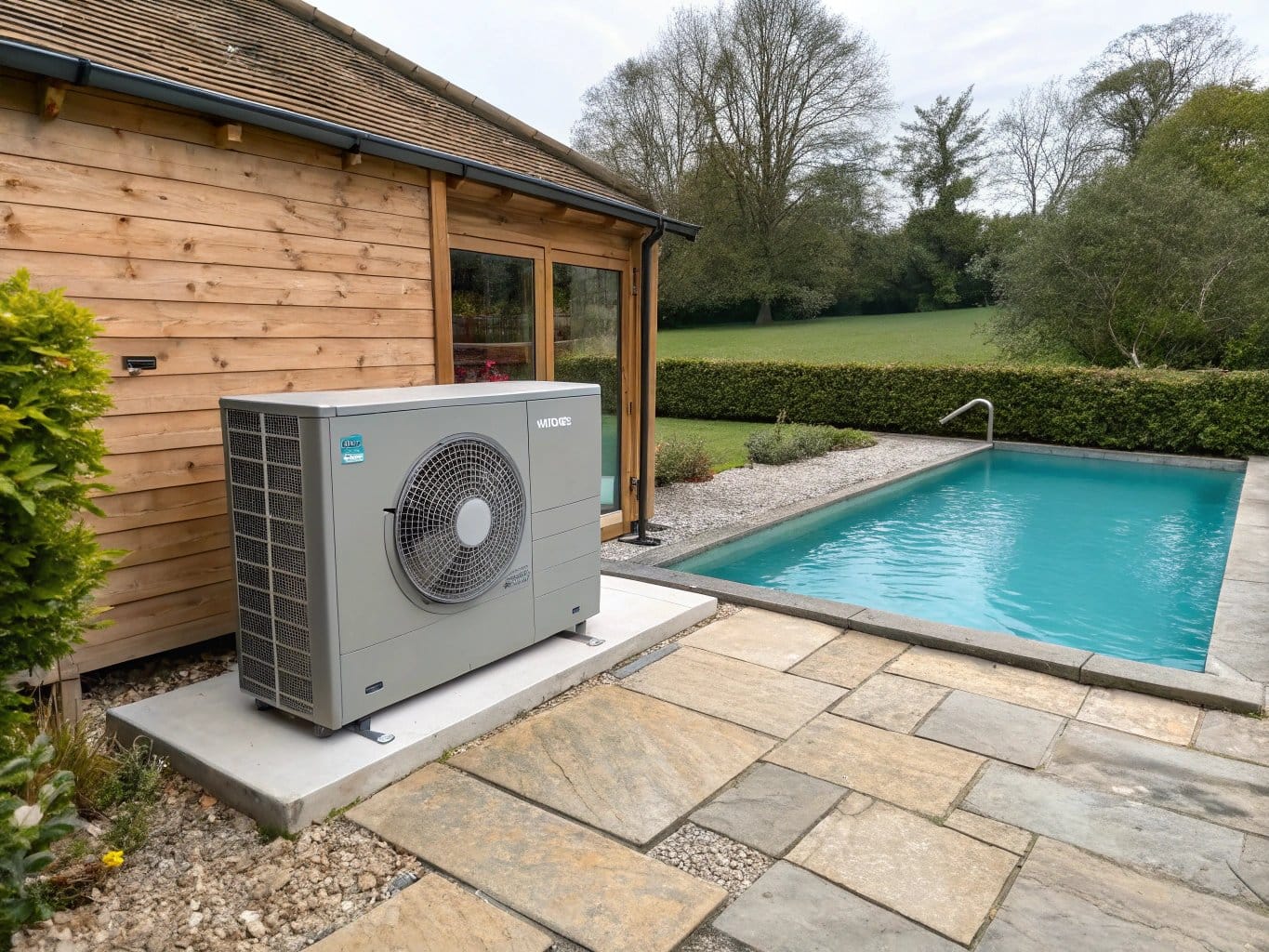
A pool heat pump does not create heat by burning fuel or running a heating element. It moves heat that is already in the outside air into your pool water, using the same refrigeration cycle as a fridge, only in reverse. Electricity powers the fan and compressor, but most of the heat that ends up in the water comes from the air.
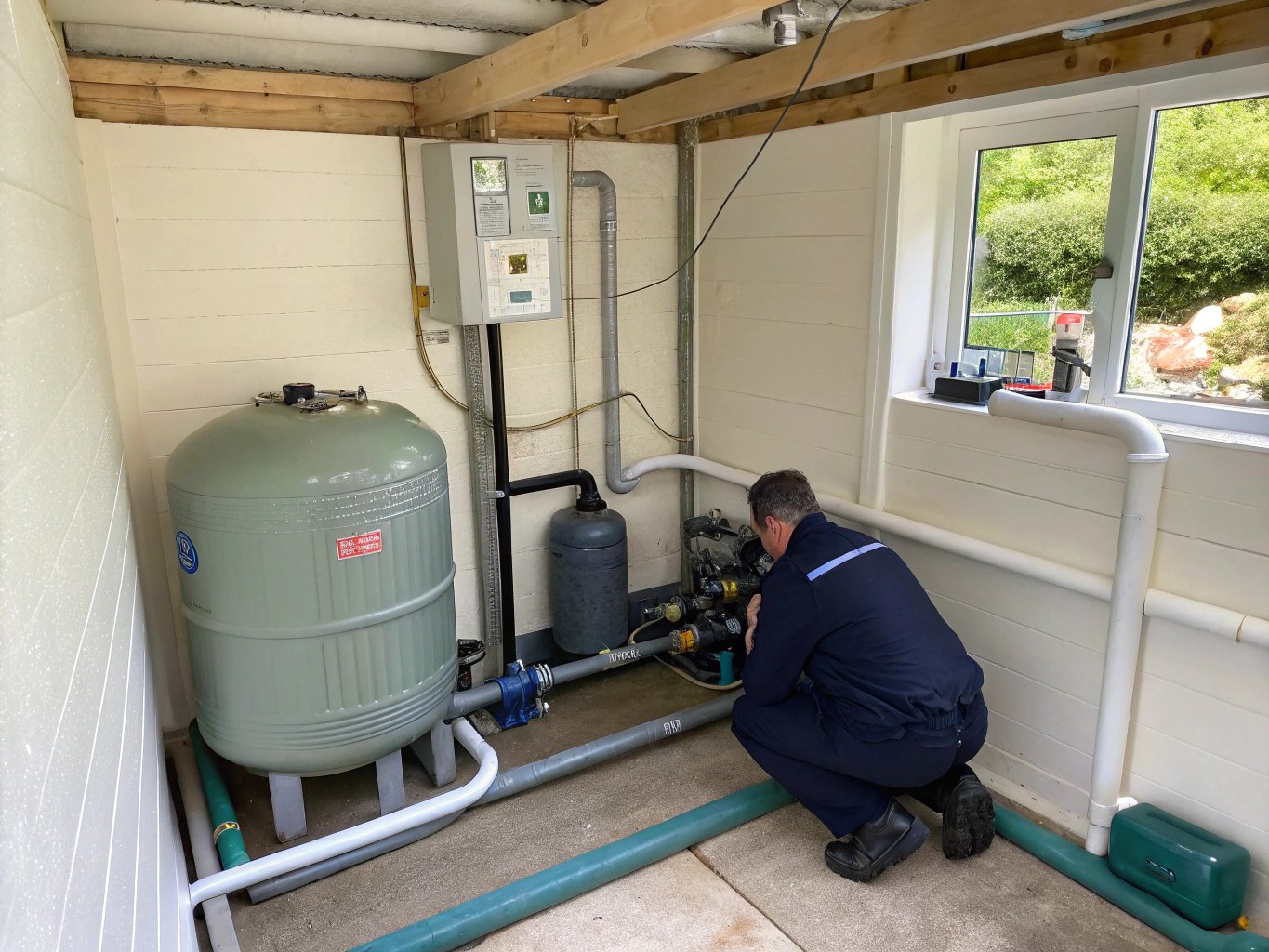
Water reaches the heat pump through your existing filtration system. It is normally plumbed in after the filter and before any chlorinator or dosing equipment, with a set of bypass valves so that you can control how much water flows through it, or take it out of the circuit altogether.
COP: the number that decides your running costs
Heat pump efficiency is measured as a coefficient of performance (COP). A COP of 5 means that for every 1 kWh of electricity the unit uses, it delivers 5 kWh of heat into the water. A direct electric heater, by comparison, has a COP of 1.
Treat brochure figures with care. Pool heat pumps are usually tested at two standard conditions: air at 27°C with water at 27°C, and the more realistic air at 15°C with water at 26°C. The headline figure of 6, 7 or more is almost always the warm-air one. Across a real UK season, a COP of roughly 3 to 5 is a more honest expectation, rising on warm days and falling on cool ones.
Inverter or on/off?
Older and cheaper units are on/off: the compressor runs flat out until the water reaches temperature, then stops. Inverter models vary the speed of the compressor and fan, running hard when the pool is cold and gently once it is close to temperature. They cost more to buy, but they are quieter, more efficient for most of the time they run, and better at holding a steady temperature. For an in-ground pool that you plan to keep warm all season, an inverter unit is usually the better buy.
Swimming Pool Heat Pump vs Other Ways to Heat a Pool
If you are wondering how to heat a swimming pool at the lowest cost, the fairest comparison is the cost of putting 1 kWh of heat into the water. The table below uses the Ofgem price cap for 1 October to 31 December 2026: an average of 26.32p per kWh for electricity and 7.97p per kWh for gas.
| Heating method | Approx. cost per kWh of heat | Upfront cost | Good to know |
|---|---|---|---|
| Heat pump, warm weather (COP 5) | 5.3p | Moderate to high | Cheapest to run from late spring to early autumn |
| Heat pump, cool weather (COP 3.5) | 7.5p | Moderate to high | Still competitive, but output and efficiency fall as the air cools |
| Gas pool heater (about 85% efficient) | 9.4p | Lower than a heat pump | Heats fast in any weather; needs a gas supply and flue |
| Direct electric heater | 26.3p | Lowest | Only sensible for very small pools or occasional top-ups |
| Solar panels or matting | Close to nothing (pump only) | Low to moderate | Free heat on sunny days, very little on dull ones |
Figures exclude standing charges and assume the price cap average rate. Your own tariff, and the real-world efficiency of the equipment, will move these numbers, so use them as a comparison rather than a quote.
Two things stand out. A heat pump is the cheapest way to run pool heating for most of the swimming season, but at current prices the gap with gas is narrower than many people expect, especially in cooler weather. And direct electric heating costs roughly four to five times as much as a heat pump for the same warmth. Gas heaters still have a place where a pool needs heating quickly, or is used well into autumn, and some owners combine the two.
Does a Pool Heat Pump Work in the UK Climate?
Yes, but the weather sets the limits. Because a heat pump takes its heat from the air, it works best in exactly the months when most people want to swim, and it slows down when the air is cold.
| Air temperature | What to expect |
|---|---|
| Above 15°C | Good output and efficiency. The ideal time to run the heat pump. |
| 10 to 15°C | Still works well, but output drops and each degree of heat costs more. |
| Below about 10°C | Ice can start to form on the coil, so the unit spends time defrosting. Efficiency falls noticeably. |
| Near or below freezing | Many inverter units can still run, some down to -10 or -15°C, but heating an outdoor pool in these conditions is rarely good value. |
For an outdoor pool in Bedfordshire, Hertfordshire or London, a well-sized heat pump and a good cover will typically give you a comfortable swimming season from May to the end of September, with April and October possible in a mild year. For indoor pools, where air temperatures are controlled, heat pumps can run all year round.
What Size Swimming Pool Heat Pump Do You Need?
Pool heat pumps are rated by their heat output in kilowatts (kW). Undersizing is one of the most common mistakes: it runs constantly, struggles to reach temperature in spring, and can end up costing more than a properly sized one. The main factors are:
- Pool volume and surface area. Volume decides how much energy it takes to warm the pool; surface area decides how quickly it loses that heat.
- Whether you use a cover. An uncovered pool loses heat every night, mostly through evaporation, and needs roughly a third more heating power.
- How long a season you want. Heating from late April needs more power than heating from June.
- Target temperature. Most home pools are set between 26 and 28°C. Every extra degree adds to the load.
- Exposure. A windy, open site loses heat faster than a sheltered, walled garden.
| Pool volume | Typical minimum output (with a cover) | Without a cover (about 35% more) |
|---|---|---|
| 15 to 30 m³ | 6 kW | 8 kW or more |
| 30 to 40 m³ | 9 kW | 12 kW or more |
| 40 to 60 m³ | 12 kW | 16 kW or more |
| 60 to 80 m³ | 16 kW | 22 kW or more |
These are starting points, not a specification. Many UK installers size more generously than this to give a longer season and faster heat-up, so a 45 m³ pool fitted with a 14 kW unit would not be unusual. A proper assessment looks at your pool, your site and how you use it.
Pool heat pump size and heating cost calculator
Enter your pool's measurements to get a rough size range, how much it would cost to warm the pool from cold, and the approximate cost per hour of running.
Heat Pump Calculator
Average depth = (shallow end depth + deep end depth) ÷ 2. The default electricity price is the Ofgem cap average for October to December 2026.
How Much Does a Swimming Pool Heat Pump Cost?
Buying and installing a heat pump
Prices vary enormously, from small plug-in units sold for above-ground pools to commercial machines. For a typical in-ground garden pool, these are realistic ranges for an established brand with an inverter compressor:
| Pool size | Typical output | Unit price | Installation | Typical total |
|---|---|---|---|---|
| Up to about 30 m³ | 9 to 10 kW | £3,500 to £5,000 | £1,000 to £2,000 | £4,500 to £7,000 |
| About 50 to 70 m³ | 12 to 15 kW | £3,800 to £6,500 | £1,000 to £2,200 | £4,800 to £8,700 |
| About 100 to 140 m³ | 20 to 28 kW | £6,000 to £8,500 | £1,500 to £2,500 | £7,500 to £11,000 |
Indicative UK supplier prices published in 2026. Budget plug-and-play units for small above-ground pools start from a few hundred pounds, but they are not designed for a full-size in-ground pool.
Installation covers the base, plumbing into your filtration with a bypass, condensate drainage and, separately, the electrical supply. If your pool equipment is being replaced anyway, adding a heat pump during a pool refurbishment or as part of a new pool build keeps the plumbing and electrical work simpler and cheaper.
Swimming pool heat pump running costs
Running costs depend on three things: the electricity your unit draws, how efficiently it is working, and how many hours it runs. As a guide, a 15 kW heat pump working at a COP of 4 draws about 3.75 kW, which costs roughly £1 an hour at 26.32p per kWh. At a COP of 5 on a warm day, that falls to about 79p an hour.
Worked example: an 8 x 4 m pool with an average depth of 1.5 m holds 48 m³ of water. Warming it from 14°C to 27°C at the start of the season takes about 726 kWh of heat. At a COP of 4, that is around 181 kWh of electricity, or roughly £48, spread over two to three days of running. After that, the cost depends almost entirely on how much heat the pool loses, which is why a cover matters so much.
Are there grants for swimming pool heat pumps?
No. The Boiler Upgrade Scheme in England only funds heat pumps that provide space heating and hot water for a property, and its rules specifically exclude water used for heating a swimming pool. Be wary of anyone suggesting a pool heat pump qualifies for a government grant.
Installing a Pool Heat Pump: What's Involved
Where the heat pump goes
Heat pumps need plenty of free air around them, so they are installed outside, usually close to the plant room to keep pipe runs short. The unit sits on a level concrete base or anti-vibration feet, with clear space in front of the fan and around the coil, and somewhere for condensate water to drain away. Think about neighbours too: modern inverter units are quiet, but the fan should not point at a bedroom window or a boundary.
Electrical supply
A pool heat pump needs its own dedicated circuit with the correct protection, installed and certified by a registered electrician. Adding a new circuit is notifiable building work in England. Most domestic units run on a normal single-phase supply, but some of the largest models need three-phase power, so check this before you choose a unit.
Do you need planning permission?
How to Get the Most From Your Pool Heat Pump
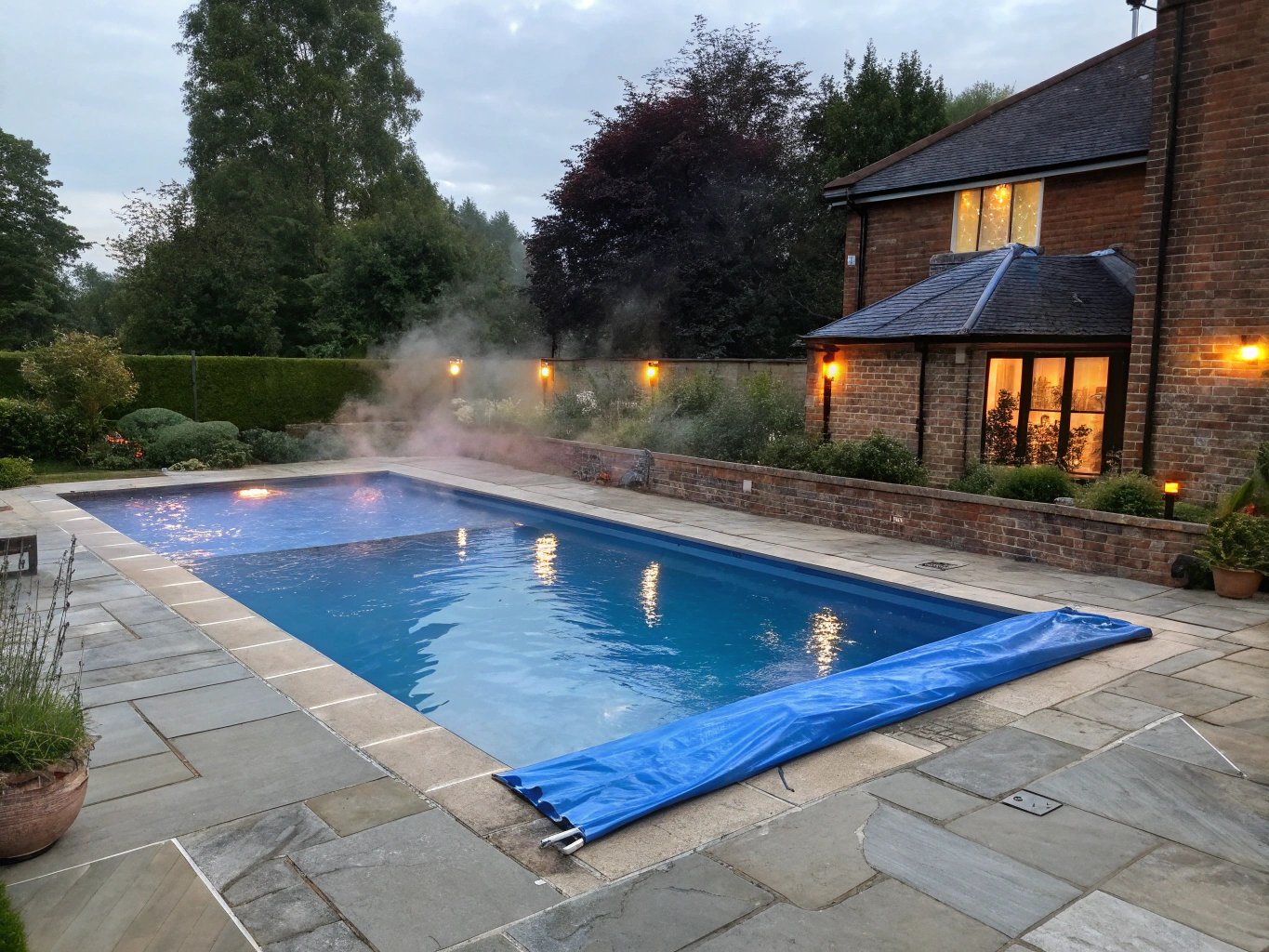
- Cover the pool whenever it is not in use. Most heat is lost from the surface, mainly through evaporation, and a good solar cover can cut evaporation by up to 95%. A cover is the single biggest saving you can make, and it lets you use a smaller heat pump. We supply and fit solar, automatic and safety pool covers.
- Hold the temperature rather than reheating. Letting the pool cool during the week and reheating it for the weekend usually costs more than keeping it steady, because the heat pump has to work through the cooler evening hours to catch up.
- Set a sensible target. 26 to 28°C suits most families. Pushing higher costs more and increases evaporation.
- Run it in the warmest hours. Programme the heat pump and filtration to run mainly during the day.
- Keep the water balanced. Warm water uses chlorine faster and is more prone to scale and algae. Our guide to swimming pool water chemistry covers the ranges to aim for.
- Keep the coil and filter clean. Leaves and dust on the evaporator coil, or a dirty filter restricting flow, both reduce efficiency.
Common Pool Heat Pump Mistakes
Buying too small
A small unit looks good value until it runs for days in May without getting the pool above 22°C. Size for the season you actually want, not the cheapest price.
Heating without a cover
An uncovered pool can lose much of a day's heating overnight. Without a cover, you are paying to heat the air above your garden.
Comparing units on headline COP alone
Compare like with like: check the COP at 15°C air temperature, not just the warm-air figure, along with noise levels and whether the unit is a true inverter.
Forgetting the heat pump at winterising time
Water left in the heat exchanger can freeze and split it, and a replacement is expensive. When you close the pool, the heat pump needs isolating and draining with the rest of the plant. Our guide on how to winterise a swimming pool covers this step by step.
Are Swimming Pool Heat Pumps Worth It?
For most outdoor pools in the UK, yes. A swimming pool heat pump is the most efficient way to heat a pool through the main swimming season, it is much cheaper to run than direct electric heating, and it can turn a pool that is too cold to enjoy for most of the year into one the family uses from May to September.
It is less clear-cut if you mainly want to swim in early spring or late autumn, when the air is cold and a heat pump's output drops. In those cases a larger unit, a gas heater or a combination of the two may suit you better. And whichever you choose, the savings depend on a good cover. A heat pump without one will always cost more to run than it should.
Need Help Choosing a Swimming Pool Heat Pump? DP Pool Services Can Help
Whether you want to add heating to an existing pool or plan it into a new one, DP Pool Services has been caring for pools across Bedfordshire, Hertfordshire, Buckinghamshire, Cambridgeshire, Northamptonshire and London for over 30 years.
We can assess your pool and site, recommend the right size of heat pump, and install it as part of a new pool build or refurbishment. We also supply and fit pool covers, and look after heat pumps as part of our regular pool servicing and maintenance.
Call us on 07748 142023 or get in touch online for a free, no-obligation quote.
Frequently Asked Questions
How much does it cost to run a swimming pool heat pump?
A typical 15 kW unit costs roughly 80p to £1 an hour to run at current electricity prices, depending on the weather. Warming a 48 m³ pool from 14°C to 27°C costs around £48. See running costs above, or use the calculator for your own pool.
What size heat pump do I need for my pool?
As a rough guide, a covered pool of 40 to 60 m³ needs at least 12 kW, and an uncovered one about a third more. Season length, exposure and target temperature all matter, so see our sizing guide and get a proper assessment before buying.
Do pool heat pumps work in winter in the UK?
Many will run in near-freezing conditions, but output and efficiency fall sharply below about 10°C, so heating an outdoor pool in winter is rarely good value. Outdoor pools are usually heated from May to September, while indoor pools can be heated all year.
Is a heat pump cheaper to run than a gas pool heater?
Usually, yes, though by less than many people expect. At the October to December 2026 price cap, a heat pump delivers heat for roughly 5 to 7.5p per kWh, against about 9.4p for a gas heater. Gas heats faster in cold weather. See the full comparison.
How long does it take to heat a pool with a heat pump?
Bringing a pool up to temperature from cold at the start of the season typically takes two to four days of running, depending on the size of the pool and the unit and on the weather. After that, a correctly sized heat pump holds the temperature steadily.
Do I need planning permission for a pool heat pump?
Usually not in England, as long as the installation meets permitted development conditions, including the MCS 020 noise standard. Listed buildings and some conservation areas may need consent. See planning permission above.
Can I get a grant for a swimming pool heat pump?
No. The Boiler Upgrade Scheme does not cover heat pumps used to heat swimming pools.
Key Takeaways
- A swimming pool heat pump moves heat from the air into your pool, typically delivering 3 to 5 kWh of heat for every 1 kWh of electricity across a UK season.
- At October to December 2026 energy prices, it is the cheapest way to heat a pool in summer, at roughly 5 to 7.5p per kWh of heat, but only modestly cheaper than gas in cool weather.
- Size it for the season you want: a covered 40 to 60 m³ pool needs at least 12 kW, and an uncovered one around a third more.
- Expect roughly £4,500 to £11,000 fully installed for an in-ground pool, with no grants available.
- A pool cover is the biggest single saving and lets you run a smaller unit for less.
- Drain and protect the heat pump when you winterise, or frost can split the heat exchanger.
Related Articles
- How to Winterise a Swimming Pool: Complete UK Guide: including how to drain and protect your heat pump over winter.
- Swimming Pool Water Chemistry: pH, Chlorine & Alkalinity: keeping warm water balanced through the season.
- Why Is My Pool Cloudy? Causes & How to Clear It Fast: why heated pools can turn hazy and how to fix it.
- Green Swimming Pool? Causes, Fixes & How to Prevent It: stopping algae taking hold in warm water.
0 Comments