
You walk out to the pool expecting the usual sparkle and instead you get a hazy, milky mess, or worse, you can no longer see the bottom at all. A cloudy pool is one of the most common problems pool owners face, and thankfully one of the most fixable. In this guide we will walk through exactly why your pool has turned cloudy, how to diagnose the specific cause, and the step-by-step process to get it crystal clear again. Whether the issue is chemistry, filtration or contamination, you will find a practical fix below.
Cloudy vs Hazy: Why the Distinction Matters
Before diagnosing the cause, it helps to be precise about what you are looking at. Pool professionals use two different terms and the distinction actually changes what you should do next.
- Hazy water: you can still make out the bottom of the pool, but the detail is soft and slightly blurred.
- Cloudy water: the bottom of the pool is not visible at all, and the water often takes on a milky or grey tinge.
Hazy water is usually an early warning sign that chemistry or filtration is drifting out of range. Cloudy water means the problem has been building for a while and needs a more thorough response. Either way, the causes fall into three broad categories: water chemistry, filtration, and contamination. Most cloudy pools are dealing with more than one of these at once.
Cause 1: Water Chemistry Out of Balance
Roughly nine times out of ten, chemistry is either the root cause or a major contributing factor. Three readings matter most here: pH, total alkalinity and chlorine.
High pH and High Total Alkalinity
When pH climbs above 7.6, and particularly once it reaches 8.0 or higher, calcium in the water can no longer stay fully dissolved. It precipitates out as extremely fine particles that scatter light and give the water a milky, cloudy appearance. This is called limescale or calcium precipitation, and it is especially common in hard water areas of the South of England. High total alkalinity behaves in a similar way and tends to drag pH upwards with it, so the two problems often arrive together.
Target ranges for UK residential pools, in line with PWTAG guidance, are a pH of 7.2 to 7.6 and total alkalinity of 80 to 120 ppm. If your pH tests above 7.8, that is very likely contributing to the cloudiness you are seeing.
Chlorine Too Low
When free chlorine drops too low, the pool loses its ability to oxidise the organic material that swimmers and the environment constantly introduce. Sweat, sunscreen, skin cells and airborne debris build up faster than the water can break them down, and this creates a hazy, dull look well before algae becomes visible. A free chlorine reading below 1 mg/l in an outdoor UK pool is a clear signal that sanitiser has fallen behind demand.
Chlorine Too High, or Combined Chlorine Building Up
It is also possible to overshoot. A large, sudden dose of chlorine can react with organic contaminants and create a temporary haze as the reaction runs its course. More commonly, though, what looks like a chlorine problem is actually a build-up of chloramines, the combined chlorine that forms when free chlorine binds to ammonia and nitrogen compounds from sweat and urine. Chloramines are far less effective at disinfecting and are usually the cause of that sharp "chemical" smell people associate with an overchlorinated pool, when in fact the free chlorine may be too low.
Cause 2: Filtration Problems
Even with perfect chemistry, a pool can turn cloudy if the filter is not doing its job. There are three separate filtration issues to rule out.
The Filter Needs Backwashing or Cleaning
Sand remains the most common filter type fitted to UK residential pools. As it traps debris, the sand bed clogs and its ability to catch the fine particles that cause cloudiness drops off. As a rule of thumb, backwash a sand filter when the pressure gauge reads 8 to 10 psi above its normal clean-running pressure, which for most UK residential pools works out at roughly every one to two weeks in peak summer use. Cartridge filters do not backwash; instead, remove the cartridge and hose it down thoroughly, then soak it in a filter cleaning solution a few times a season to shift oils and fine grease that a simple rinse will not remove.
Filter Media Is Worn Out
Sand loses its sharp edges over time and stops trapping fine particles effectively, even immediately after a backwash. Most UK sand filters need fresh media roughly every five to seven years. If your pool stays cloudy despite regular backwashing and correct chemistry, ageing sand is a strong suspect.
Insufficient Filtration Run Time
Every pool needs a full turnover of its water volume through the filter each day. For most UK residential pools this means running the pump for eight to twelve hours daily, depending on pool size and pump output, with longer run times needed during hot weather, after heavy pool use, or during pollen season. If your timer is set too conservatively to save on running costs, cloudiness is often the first symptom you will notice. See our servicing and maintenance page if you are unsure your current pump and filter combination is correctly sized for your pool.
Cause 3: Contaminants and Early Algae
The third category covers everything the pool picks up from swimmers and the environment. Sunscreen, body oils, sweat, pollen, dust and leaf debris all introduce fine particulate matter that a struggling filter cannot always keep pace with, particularly after a busy weekend of family swimming or a spring pollen bloom. Heavy rain can also carry debris and dilute chemical levels enough to tip a borderline pool into visibly cloudy territory.
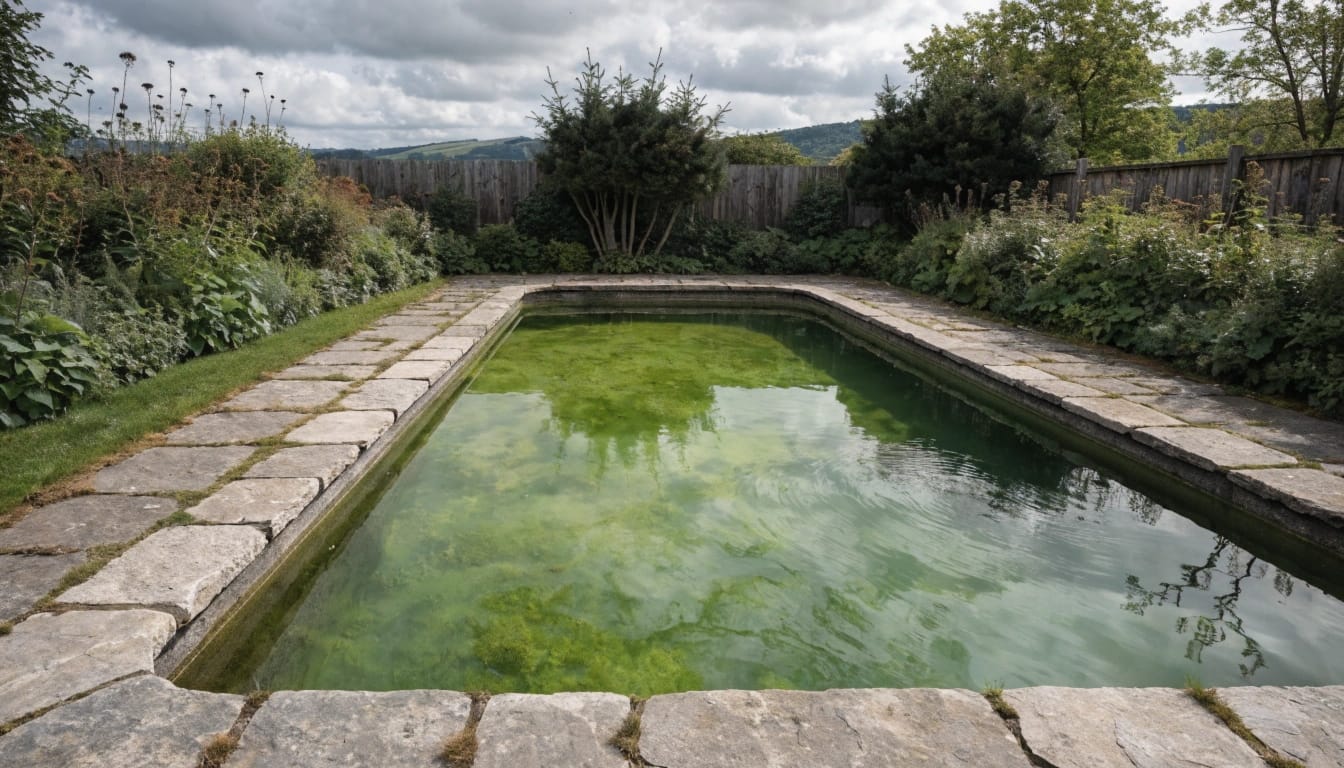
Early-stage algae is worth checking for specifically, because it behaves differently to the causes above. Algae in its very earliest form can present as a persistent grey-white haze rather than the green tint most people expect, particularly if chlorine has been struggling for a few days. If brushing the pool walls and floor releases a fine cloud of particles, or the pool has felt slightly slippery underfoot, treat it as early algae rather than a simple filtration issue. Our guide on dealing with a green swimming pool covers full algae treatment in more depth if the problem progresses.
How to Clear Cloudy Pool Water: Step by Step
Once you have an idea of the likely cause, work through this sequence. Each step builds on the last, and most cloudy pools clear within two to four days once all three are addressed together.
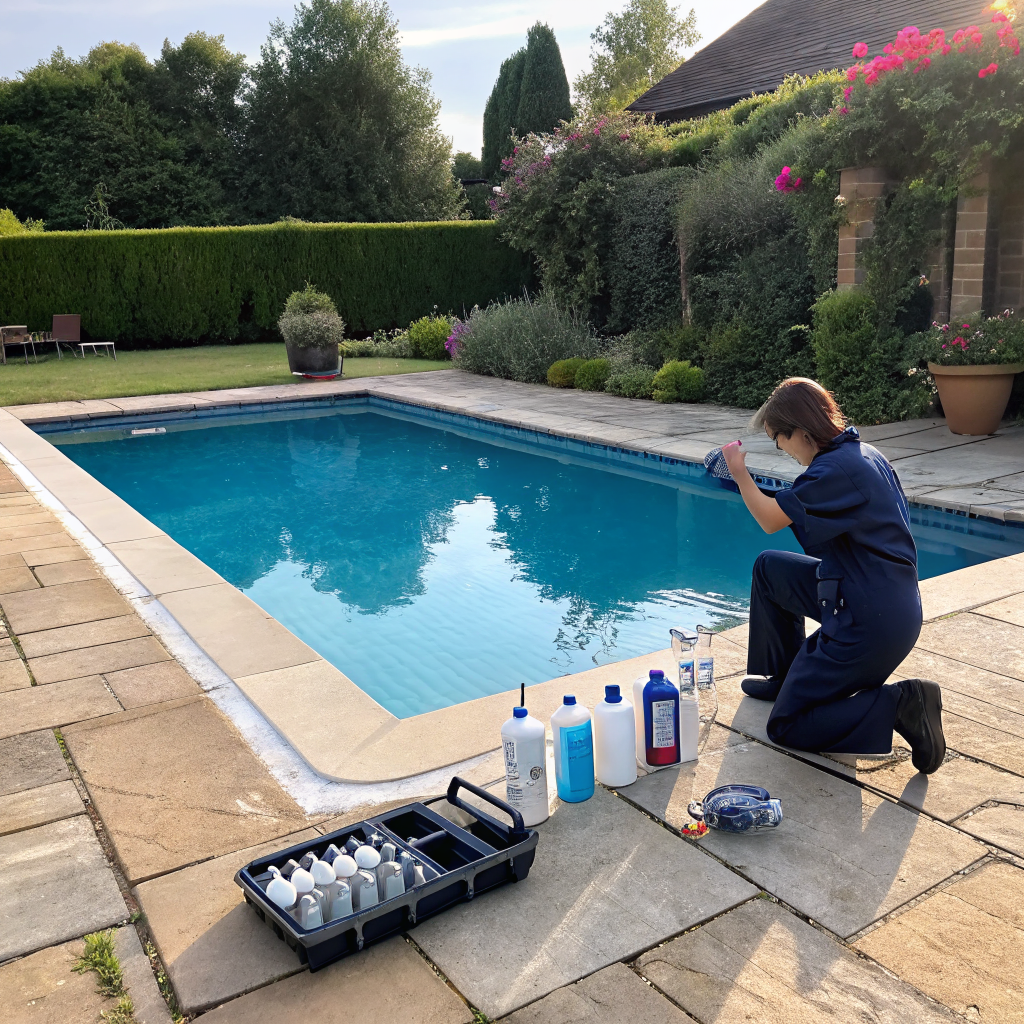
- Test your water. Check free chlorine, combined chlorine, pH and total alkalinity before touching anything. This tells you which of the causes above you are actually dealing with, rather than guessing.
- Correct pH and alkalinity first. If pH is above 7.6, bring it down into the 7.2 to 7.6 range before doing anything else. Chlorine works far less effectively at high pH, so skipping this step undermines everything that follows.
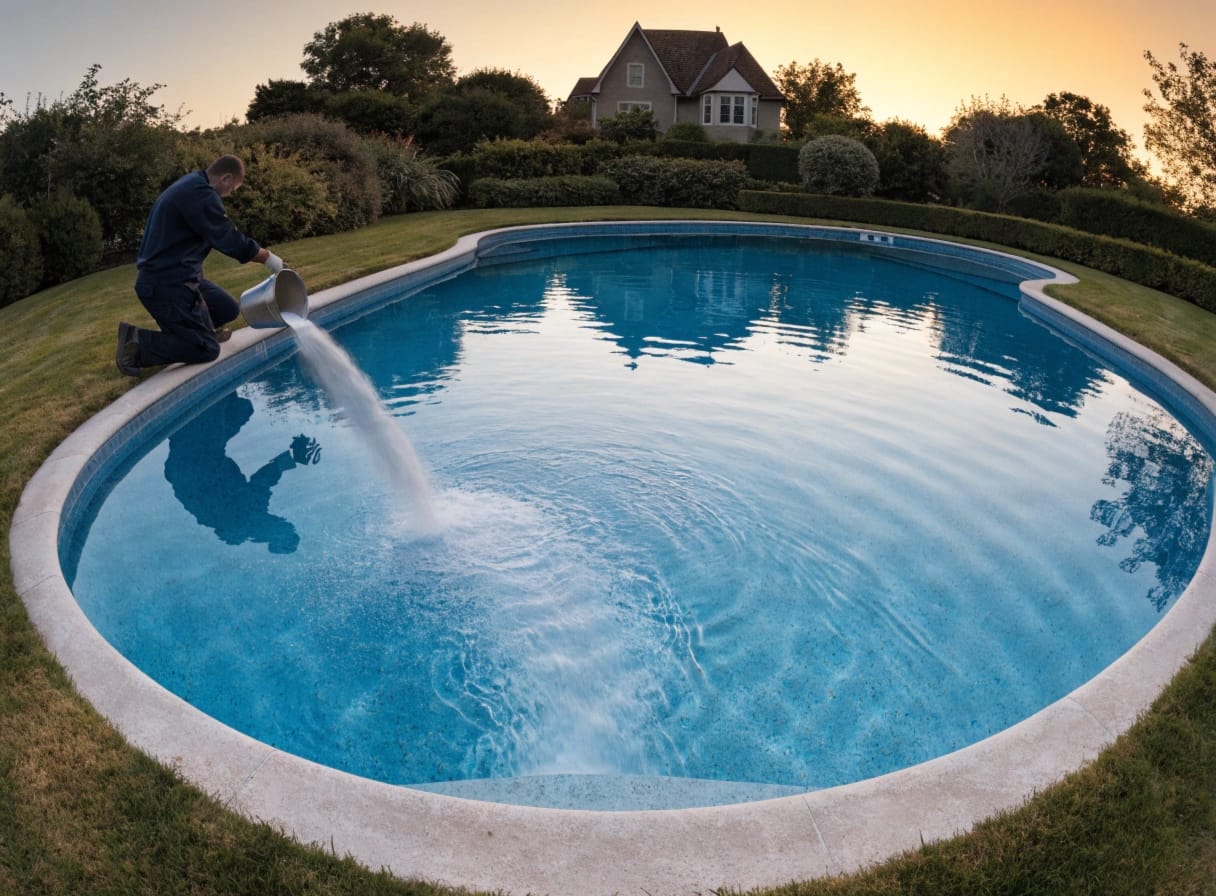
- Shock the pool. A shock dose of chlorine oxidises the organic contaminants and chloramines causing the haze, and knocks back any early algae growth at the same time. Use the calculator below to work out the right dose for your pool.
- Run the filter continuously. For the 24 to 48 hours after shocking, run the pump around the clock rather than on your usual timer. This is the single biggest factor in how quickly a cloudy pool clears.
- Backwash or clean the filter. Do this the day after shocking, once the bulk of the dead algae and contaminants have been captured, so you are not immediately reloading a freshly cleaned filter.
- Consider a clarifier or flocculant if particles are very fine. A clarifier coagulates microscopic particles into clusters your filter can catch. A flocculant is stronger and drops particles to the pool floor for vacuuming to waste, which is useful when cloudiness is severe, but only use it once chemistry is already balanced.
- Retest daily until clear. Keep testing chlorine and pH each day during the recovery period. It is common for chlorine demand to stay elevated for a day or two after shocking as the last of the contaminants are broken down.
Pool Shock Dose Calculator
This calculator gives an approximate dose based on standard granular calcium hypochlorite shock. Always follow the manufacturer's instructions on the product you are using, dose in the evening after swimmers have left, and never mix different chlorine products together.
Comparing the Causes at a Glance
| Symptom | Likely Cause | First Fix |
|---|---|---|
| Milky white haze, high pH reading | Calcium precipitation from high pH or alkalinity | Lower pH into the 7.2 to 7.6 range |
| Strong chemical smell, dull water | Chloramine build-up (combined chlorine) | Shock the pool to break down chloramines |
| Gradual haze building over days | Low free chlorine, organics accumulating | Restore chlorine to target range, shock if needed |
| High filter pressure, slow clearing | Clogged or worn filter media | Backwash or clean; replace sand if over 5 to 7 years old |
| Cloudiness after a busy swim day | Sunscreen, oils and organic contaminants | Extend filtration run time, consider a clarifier |
| Grey-white haze, slippery pool surfaces | Early-stage algae | Brush thoroughly and shock immediately |
Common Mistakes That Make Cloudy Water Worse
- Adding clarifier before fixing chemistry. A clarifier cannot compensate for imbalanced pH or low chlorine. Sort the chemistry first, then use a clarifier only if fine particles remain.
- Vacuuming to the filter during an algae bloom. Live algae cells are small enough to pass straight through a sand filter and land right back in the pool. Vacuum to waste instead if you suspect algae.
- Reducing filter run time to save money mid-problem. This is exactly the wrong moment to cut back. Extra filtration time during recovery is what actually clears the water.
- Overdosing chlorine repeatedly without retesting. Adding more chlorine on top of an already high reading will not clear a chemistry-balance problem and can push pH and stabiliser out of range instead.
- Ignoring a persistently high filter pressure. If backwashing no longer brings the pressure back down to baseline, the sand needs replacing rather than more frequent backwashing.
When to Call a Professional
Most cloudy pool problems clear within a few days of working through the steps above. It is worth calling in a professional if the water has stayed cloudy for more than a week despite balanced chemistry and a clean filter, if you cannot get filter pressure back down after backwashing, or if you suspect your pump or filter is simply undersized for your pool. A worn-out sand bed, a failing pump, or a filtration system that was never quite right for the pool volume are all things a technician can diagnose far faster than ongoing trial and error at home.
Need Help with Cloudy Pool Water? DP Pool Services Can Help
Whether you need a professional water test, a filtration system upgrade, or want an expert to handle the whole clean-up for you, DP Pool Services has been caring for pools across Bedfordshire, Hertfordshire, Buckinghamshire, Essex, Cambridgeshire, Northamptonshire and Greater London for over 30 years.
We offer regular pool servicing and maintenance, filter and pump diagnostics, and full chemical balancing, all carried out by our experienced, SPATA-registered team.
Call us on 07748 142023 or get in touch online for a free, no-obligation quote.
Frequently Asked Questions
How long does it take to clear a cloudy pool?
Most cloudy pools clear within two to four days once the step-by-step process above is followed correctly, particularly the step of running the filter continuously during recovery. Severe cases involving heavy algae or very worn filter media can take a week or more.
Can I swim in a cloudy pool?
It is best avoided. Cloudy water often means chlorine is not effectively sanitising the pool, and reduced visibility is also a safety concern, particularly for children. Wait until the water has cleared and chemistry is back in range before swimming again.
Will a pool clarifier fix cloudy water on its own?
Not usually. A clarifier helps your filter catch very fine particles once your chemistry is already balanced, but it cannot correct high pH, low chlorine or a clogged filter on its own. Use it as a finishing step rather than a first response.
Why is my pool cloudy even though the chlorine reading is fine?
Check pH and total alkalinity next. High pH is one of the most commonly overlooked causes of cloudy water because pool owners often check chlorine first and stop there. Also check combined chlorine specifically, as normal-looking free chlorine can mask a chloramine problem.
Does rain make pool water cloudy?
Yes, heavy rain can introduce debris and dilute your chemical levels enough to trigger cloudiness, particularly if the pool was already borderline on chlorine or pH beforehand. Retest after any significant rainfall.
How often should I backwash my sand filter?
Backwash when the pressure gauge reads 8 to 10 psi above its clean running pressure, which for most UK residential pools in peak season works out at roughly every one to two weeks. Always go by pressure rather than a fixed calendar schedule.
Is cloudy water always a sign of algae?
No. Chemistry imbalance and filtration problems are more common causes than algae. Check for a slippery pool surface or a fine cloud released when brushing the walls, which are the clearest signs that algae specifically is involved.
Key Takeaways
- Cloudy pool water almost always comes down to chemistry, filtration, or contaminants, often more than one at once.
- Test before you treat. Guessing at a fix without testing pH, chlorine and alkalinity first often makes the problem worse.
- High pH causing calcium precipitation is one of the most overlooked causes, especially in hard water areas.
- Running the filter continuously for 24 to 48 hours is usually the single biggest factor in how fast a cloudy pool clears.
- If cloudiness persists for more than a week despite balanced chemistry and a clean filter, it is time to call a professional.
Related Articles
- Why Is My Pool Green? How to Diagnose and Treat a Green Swimming Pool: the full algae treatment process if brushing and shocking are not enough.
- Swimming Pool Water Chemistry: A Complete Guide to pH, Chlorine & Alkalinity: the full reference guide to every reading mentioned in this article.
- Our pool servicing and maintenance services: for regular chemical balancing and filtration checks throughout the season.
0 Comments