
Most pool problems, including cloudy water, skin irritation, persistent algae and premature wear on liners and equipment, trace back to the same root cause: chemistry that has drifted out of balance. Pool water chemistry sounds technical, but it really comes down to five key parameters that work together to keep your water safe, clear and comfortable to swim in. Understanding pool water balance means understanding what each parameter does, what the correct ranges are, and what order to adjust them in when something goes wrong. This guide covers everything UK pool owners need to know about pool pH, chlorine for swimming pools, total alkalinity, cyanuric acid and calcium hardness, including how to test accurately and when to call in the professionals.
Why Pool Water Balance Matters
Water that appears clear is not necessarily safe, and water that appears slightly cloudy is not necessarily dangerous. The only reliable way to know what is happening in your pool is to test it regularly. Unbalanced water causes two categories of problem: damage to the pool and its equipment, and health risks to swimmers.
Corrosive water, typically water with low pH, low alkalinity or low calcium hardness, attacks plaster, grout, tile, pipework and heat exchanger coils. Scale-forming water tends to result from high calcium hardness combined with high pH and leaves white crusty deposits on tile lines and inside heaters, where it acts as an insulator and accelerates component failure. Neither extreme is obvious until damage has already occurred.
For swimmers, poorly balanced water most commonly presents as stinging eyes, itchy skin and that distinctive chemical smell that is often wrongly blamed on chlorine. In reality, the smell associated with a poorly maintained pool comes from chloramines, which are a by-product of chlorine reacting with organic matter rather than a sign of too much chlorine.
The Five Parameters of Pool Water Balance
Think of pool water chemistry as a set of interlocking dials. Move one and the others shift in response. The five parameters below are the ones every pool owner needs to understand and monitor throughout the swimming season.
| Parameter | Target Range (UK) | What Goes Wrong If Out of Range |
|---|---|---|
| pH | 7.2 – 7.6 | Chlorine loses effectiveness above 7.6; corrosion and irritation set in below 7.2 |
| Free Chlorine | 1.0 – 3.0 mg/L (ppm) | Bacteria and algae take hold below 1.0 mg/L; eye and skin irritation above 3.0 mg/L |
| Total Alkalinity | 80 – 120 mg/L (ppm) | pH instability and "bounce" below 80 mg/L; pH lock above 150 mg/L |
| Cyanuric Acid (Stabiliser) | 30 – 50 mg/L (ppm) | Chlorine degrades rapidly in UV below 30 mg/L; chlorine becomes ineffective above 75 mg/L |
| Calcium Hardness | 200 – 400 mg/L (ppm) | Corrosive water attacks surfaces below 200 mg/L; scaling and cloudy water above 400 mg/L |
Pool pH: The Foundation of Water Balance
pH is the measure of how acidic or alkaline your pool water is, expressed on a scale of 0 to 14. A pH of 7 is neutral; below 7 is acidic, above 7 is alkaline. For pool water, the ideal range is 7.2 to 7.6, with 7.4 often cited as the sweet spot. This range closely matches the natural pH of human eyes and mucous membranes, which is why correctly balanced water feels comfortable to swim in.
What Happens When pH Goes Wrong
At pH above 7.6, chlorine rapidly loses its sanitising power. At pH 8.0, chlorine operates at less than 20% of its normal disinfecting capacity, which means even high chlorine readings will not protect your pool effectively. This is one of the most common reasons pools develop algae despite apparently adequate chlorine levels. High pH also encourages calcium scaling, particularly around the waterline and inside heaters.
At pH below 7.2, the water becomes increasingly corrosive. It will attack mortar, grouting, plaster and metal fittings, and cause noticeable irritation to swimmers' eyes and skin. Pools in hard water areas across much of southern England, including Hertfordshire, Bedfordshire and Greater London, are more prone to pH drifting upward as calcium compounds buffer the water toward alkalinity.
How to Adjust Pool pH
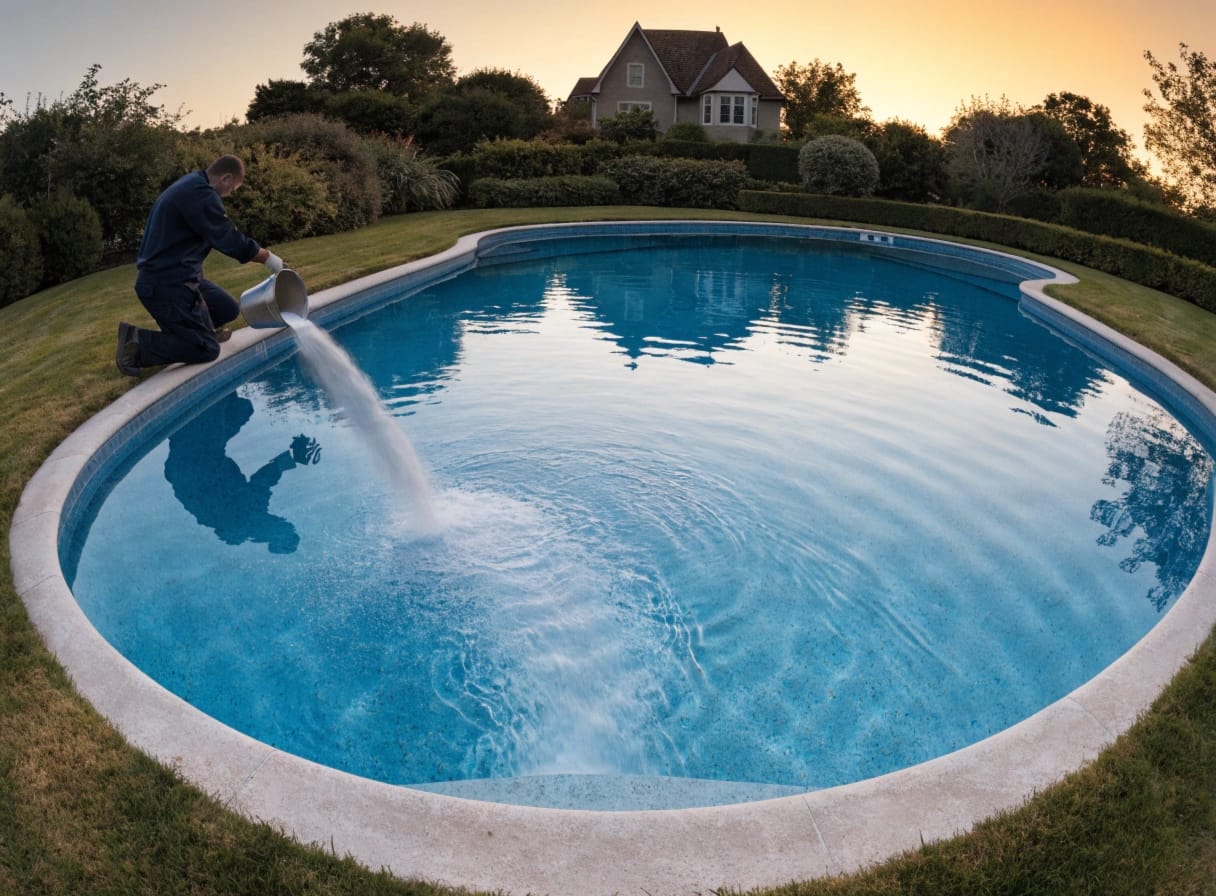
To raise pH, add pH Plus (sodium carbonate). To lower it, add pH Minus (dry acid or sodium bisulphate). Both should be dissolved in a bucket of water before adding, and the pump should be running to distribute the chemical evenly. Add small doses rather than trying to make large corrections in one go, and retest after allowing the water to circulate for at least four to six hours before adding more.
Chlorine for Swimming Pools: How It Works and What You Need
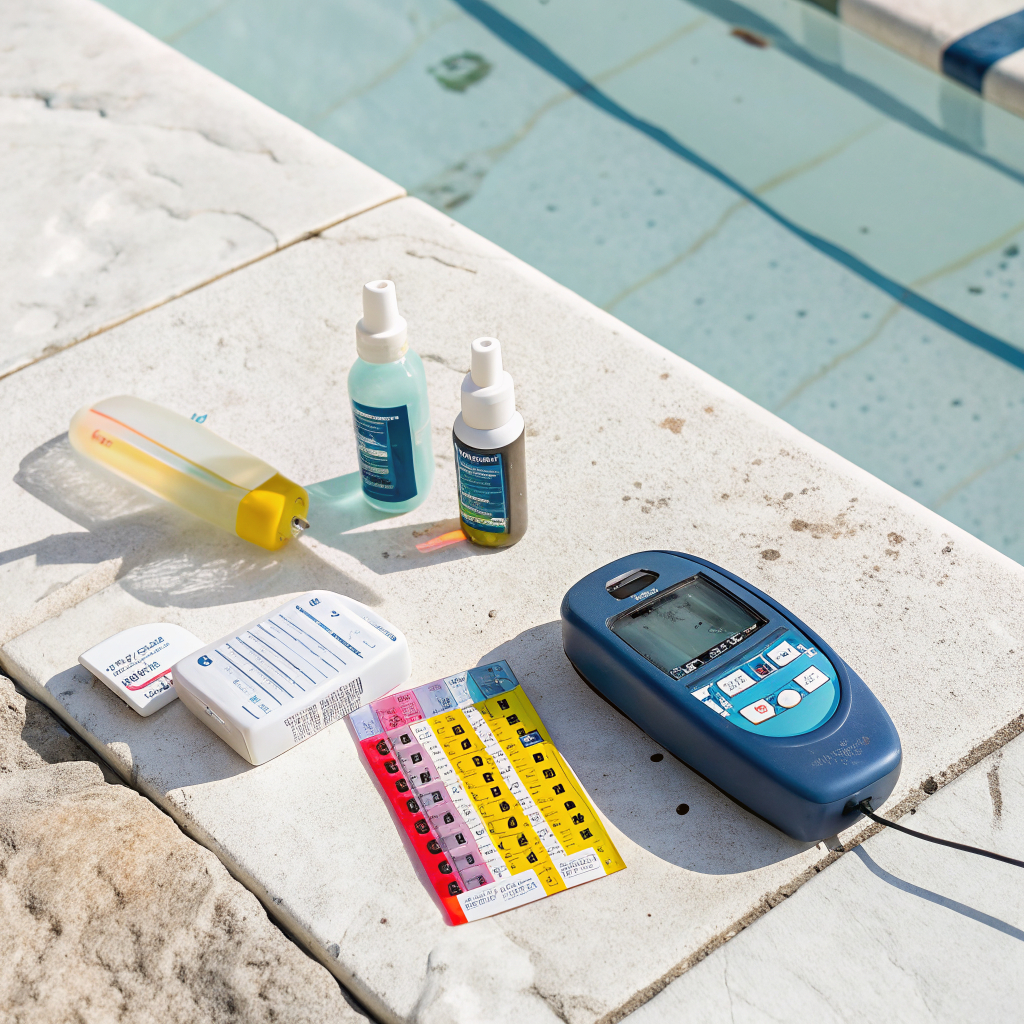
Chlorine is the most widely used pool sanitiser in the UK. It kills bacteria, viruses and algae by releasing hypochlorous acid into the water, a highly effective oxidiser that breaks down organic contaminants and destroys micro-organisms. The terms used when discussing chlorine can be confusing, so it is worth understanding the differences between them before buying or dosing.
Free Chlorine, Combined Chlorine and Total Chlorine
Free chlorine is the active, working chlorine available to sanitise your water. This is the figure you are aiming to keep in the range of 1.0 to 3.0 mg/L for outdoor pools, according to PWTAG (the Pool Water Treatment Advisory Group, whose guidance the HSE recognises as the industry standard in the UK). Free chlorine is what you test for with a DPD No. 1 tablet test.
Combined chlorine is chlorine that has already reacted with organic matter such as sweat, sunscreen, urine and leaves, and is no longer doing any useful sanitising work. Combined chlorine produces chloramines, which are responsible for the harsh smell and eye irritation associated with poorly maintained pools. PWTAG recommends keeping combined chlorine below 0.5 mg/L. If it is rising, the answer is shock treatment, not less chlorine.
Total chlorine is simply free plus combined. A pool can show an apparently healthy total chlorine reading while actually having very little free chlorine left. Always test for free chlorine specifically.
Forms of Chlorine Available in the UK
Chlorine for swimming pools is available in several forms, each with different strengths, applications and effects on water chemistry:
- Trichlor tablets (stabilised chlorine) are the most common choice for routine maintenance. Slow-dissolving and convenient, they contain cyanuric acid as a built-in stabiliser and are available in 20g and 200g sizes. Because they are acidic, regular use will gradually lower pH and, over time, raise cyanuric acid levels.
- Calcium hypochlorite granules (unstabilised chlorine) are fast-acting and ideal for shock dosing. They contain no cyanuric acid, which makes them the correct choice when CYA levels are already high or when you need rapid disinfection. They do raise calcium hardness slightly with each dose.
- Sodium dichlor granules (stabilised chlorine) dissolve faster than trichlor tablets and are pH-neutral, making them a useful option for routine dosing when you want the convenience of granules without the acidity.
- Liquid chlorine (sodium hypochlorite) is very fast-acting and leaves no stabiliser residue. More commonly used in commercial pools, it can also be practical for outdoor residential pools where CYA levels need to be kept controlled.
Shock Dosing: When and Why
Shock dosing means adding a large dose of chlorine, typically calcium hypochlorite, to rapidly raise the free chlorine level and break down chloramines and organic contamination. You should shock your pool at the start of the season when opening it, before winterising the pool at the end of the season, after a period of heavy use, after a thunderstorm, if combined chlorine rises above 0.5 mg/L, or whenever the water begins to look cloudy or dull.
For a standard outdoor residential pool of around 40,000 litres (approximately 9,000 gallons), a shock dose typically uses around 200–300g of calcium hypochlorite, dissolved in water first and added slowly via the skimmer with the pump running. Do not swim for at least 8 hours after shock dosing, and retest before use to confirm chlorine has returned to the normal range.
Pool Shock Dose Calculator
Enter your pool volume to get an estimated shock dose of calcium hypochlorite (65% available chlorine). Always follow the manufacturer's instructions on your specific product.
Swimming Pool Total Alkalinity: pH's Stabiliser
Total alkalinity (TA) is often confused with pH because the word "alkaline" appears in both. They are related but distinct. pH measures how acidic or alkaline the water is at a given moment. Total alkalinity measures the water's capacity to resist changes in pH, acting as a buffer that absorbs the effect of chemical additions and prevents pH from swinging wildly.
Target Range and What Goes Wrong
PWTAG recommends maintaining total alkalinity between 80 and 150 mg/L for UK pools, and most pool operators aim for the tighter range of 80 to 120 mg/L as a practical target. When alkalinity falls below 80 mg/L, the pH becomes highly unstable and will jump dramatically in response to small chemical additions, rain, or bather load. When alkalinity is too high, the pH becomes resistant to adjustment, a condition sometimes called "pH lock".
In practice, if you find your pH is difficult to hold steady regardless of what you add, low alkalinity is usually the underlying cause. Address alkalinity first, before attempting to correct pH.
How to Adjust Total Alkalinity
To raise TA, add alkalinity increaser (sodium bicarbonate). To lower it, add pH Minus (dry acid), which is the same product used to lower pH but applied differently. When lowering alkalinity, add the acid slowly to one spot in the pool with the pump off, rather than distributing it widely. This lets the acid work specifically on alkalinity before the pH responds. Retest after 6 to 12 hours and repeat in stages rather than trying to make a large correction at once.
Cyanuric Acid: The Chlorine Stabiliser for Outdoor Pools
Cyanuric acid, also called stabiliser or pool conditioner, is added to outdoor swimming pools to protect chlorine from being destroyed by ultraviolet light. Without stabiliser, UV rays from the sun can break down up to 35% of your free chlorine every hour. In direct summer sunlight, a correctly dosed unstabilised pool can lose virtually all its chlorine within a couple of hours. For outdoor pools in the UK, where we do occasionally get sustained sunny weather, cyanuric acid is an important part of pool water balance.
How Cyanuric Acid Works
Cyanuric acid bonds loosely to chlorine molecules, forming a protective shield that slows the rate at which UV light destroys them. It does not prevent chlorine from doing its sanitising work; it simply extends the time chlorine remains active in the water. Think of it as a sunscreen for your chlorine.
The target range for cyanuric acid in a UK outdoor residential pool is 30 to 50 mg/L. Chlorine tablets (trichlor) contain cyanuric acid as part of their formulation, so pools that rely primarily on tablets will accumulate CYA over the course of the season without any additional stabiliser being added. If you use tablets throughout summer and have not partially drained the pool over winter, CYA levels can creep up year on year.
When Cyanuric Acid Becomes a Problem
Above 75 mg/L, cyanuric acid begins to suppress chlorine's ability to kill bacteria and algae. Above 100 mg/L, chlorine can become so inhibited that it effectively stops working even when the test reads an apparently healthy free chlorine level. A pool that keeps going green despite what appears to be adequate chlorine is a classic symptom of over-stabilisation. The only solution is to partially drain the pool and refill with fresh water, as there is no chemical that removes cyanuric acid.
If your pool is maintained primarily with trichlor tablets, PWTAG guidance requires that a stabilised outdoor pool operates at a minimum free chlorine level of 3 mg/L, which is higher than the standard indoor pool minimum of 1 mg/L. This compensates for the inhibiting effect of cyanuric acid on chlorine's disinfecting power.
Calcium Hardness: Protecting Your Pool's Surfaces and Equipment
Calcium hardness (CH) refers to the concentration of dissolved calcium in your pool water. The amount of calcium in your source water varies considerably across the UK. Water in Scotland and Wales tends to be very soft, while water in southern England, particularly in Hertfordshire, Bedfordshire, north London and the home counties, can be naturally very hard, with calcium levels in source water sometimes exceeding 300 mg/L. This regional variation means calcium hardness may need active management rather than occasional attention.
Why Calcium Hardness Matters
Pool water needs calcium in it. Without enough calcium, water becomes "hungry" and begins leaching minerals from whatever it touches: plaster, grout, tile, the copper in heat exchanger coils, and metal fittings. The target range is 200 to 400 mg/L. For pools with vinyl liners, you can work toward the lower end of this range (around 175–225 mg/L); for plaster or concrete pools, aim for 200–350 mg/L to protect the pool surface from corrosion.
Too much calcium causes the opposite problem. When water becomes saturated with calcium, particularly when pH and alkalinity are also elevated, the excess calcium precipitates out of solution and deposits as scale. This white, crusty build-up appears on tile lines, water features, pipework and, most damagingly, inside pool heaters, where it acts as insulation and significantly shortens heater life. If you use calcium hypochlorite as your chlorine source, be aware that it adds calcium to the water each time you dose.
Hard Water Areas: What UK Pool Owners Need to Know
If you are in Bedfordshire, Hertfordshire, Buckinghamshire or Greater London, your tap water is likely hard to very hard. When you fill or top up a pool with hard water, you are starting with a calcium level that is already at or near the upper acceptable range. In these areas it is worth choosing a chlorine product that does not add additional calcium. Trichlor tablets or sodium dichlor granules are sensible choices for routine dosing. Our pool maintenance service includes a full water test at each visit and takes local water hardness into account when making chemical recommendations.
Raising and Lowering Calcium Hardness
To raise calcium hardness, add calcium chloride (sold as calcium hardness increaser). Dissolve it in a bucket of water before adding, as it generates significant heat on contact with water and should never be added directly to the pool. Retest after 24 hours. To lower calcium hardness, the only reliable method is to partially drain the pool and refill with softer water. If your local mains supply is very hard, you may need a sequestering agent to keep calcium in solution and prevent it depositing as scale, even within the normal range.
How to Test Your Pool Water Correctly
Testing frequency is the single biggest determinant of how easy your pool is to maintain. Weekly testing throughout the swimming season is the minimum; in hot weather, after heavy rain or following significant bather use, test more frequently. Small chemical imbalances are quick to correct. Large ones require multiple treatments, longer circulation periods, and in the case of severely elevated CYA or calcium, partial draining.
Testing Methods Available in the UK
DPD test kits (using reagent tablets and a colour comparator) are the most accurate method available to pool owners. A good quality kit will test free chlorine, combined chlorine, pH, total alkalinity and sometimes calcium hardness and cyanuric acid separately. They require a little more effort than test strips but produce significantly more reliable results.
Test strips are convenient for quick checks and are fine for monitoring between more rigorous tests, but colour comparisons can be difficult to read accurately in bright sunlight, and strips degrade quickly once the container is opened. Do not rely on them as your sole testing method.
Digital photometers are the tool of choice for professional pool technicians. They measure light absorption in a water sample to produce a precise digital reading. If you manage a larger residential pool or a commercial installation, a photometer is a worthwhile investment.
The Correct Order for Chemical Adjustments
When your test reveals that multiple parameters need adjustment, sequence matters. Adjust them in this order:
- Total Alkalinity. Get this into range first, as it underpins pH stability.
- pH. Adjust once alkalinity is stable.
- Calcium Hardness. Adjust if significantly out of range.
- Cyanuric Acid. Adjust at the start of the season or if testing reveals a problem.
- Free Chlorine. Add last, once the other parameters are within range.
Adding chlorine to water with an uncorrected high pH is a common mistake. The chlorine appears to vanish because at high pH it is genuinely working at a fraction of its effective capacity. Fix the pH first, then add chlorine.
Common Pool Chemistry Problems and How to Fix Them
Cloudy Water
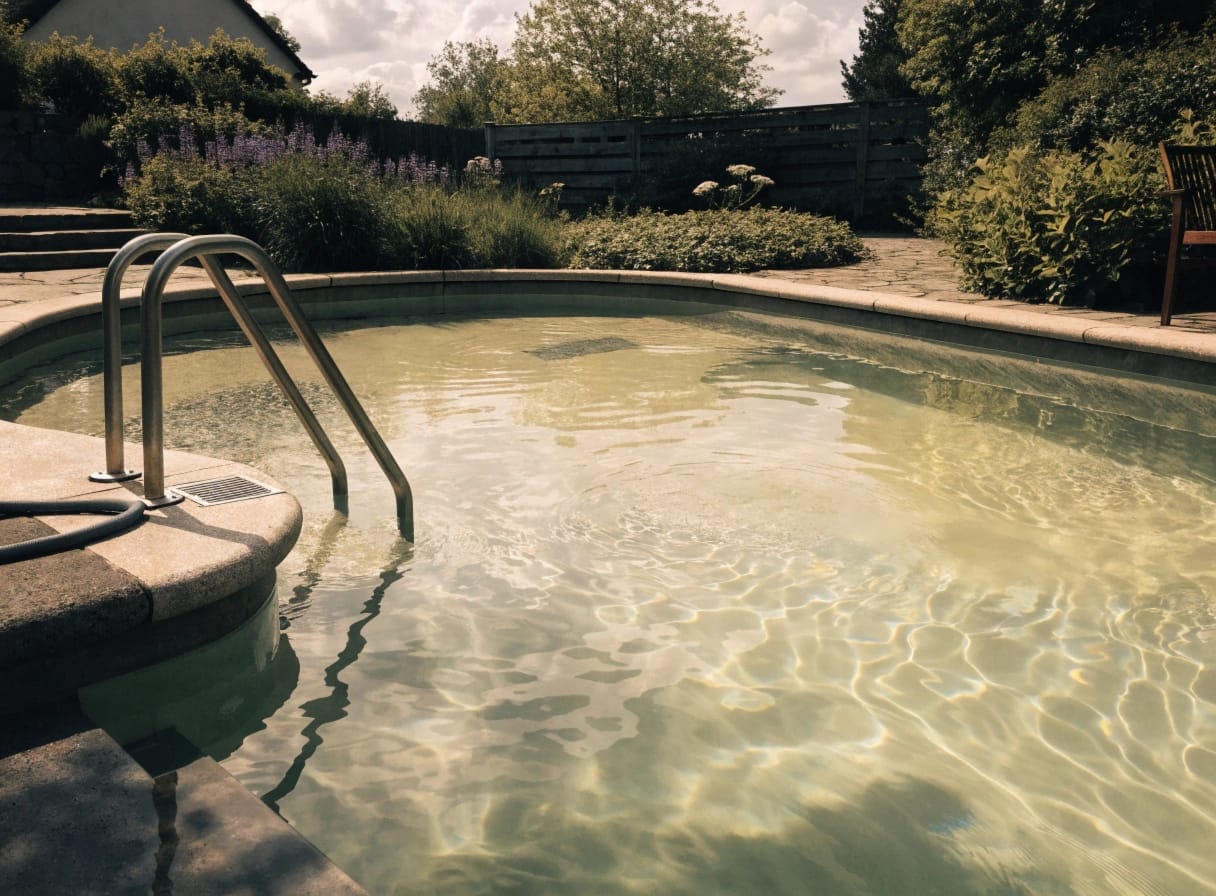
The most common causes of cloudy pool water are imbalanced pH and alkalinity, inadequate filtration, or a chlorine level that has dropped and allowed organic matter to build up. Test the water first. If pH and alkalinity are within range and chlorine is adequate, the issue is likely with filtration. Check that run times are sufficient for the pool volume and water temperature. A dose of pool flocculant followed by vacuuming to waste can help clear suspended particles.
Persistent Algae Despite Adequate Chlorine
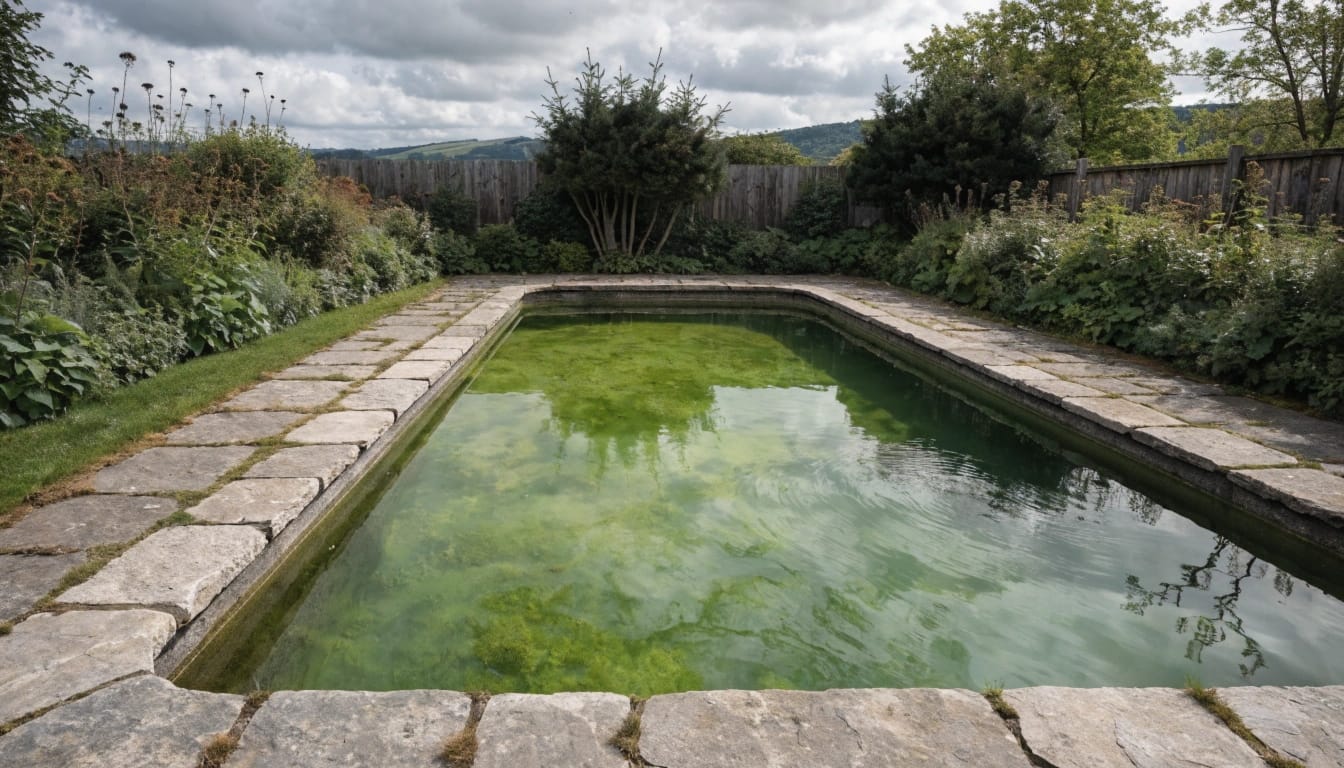
As discussed in our guide to fixing a green swimming pool, chlorine that fails to control algae is nearly always being prevented from doing so by another factor: pH above 7.6, cyanuric acid above 75 mg/L, or a combination of both. Test CYA specifically if your pool keeps going green despite shock treatment. If CYA is high, the only solution is a partial drain and refill.
Eye and Skin Irritation
Contrary to popular belief, irritation from a pool is rarely caused by having too much chlorine. It is nearly always caused by combined chlorine (chloramines). Combined chlorine above 0.5 mg/L indicates that chlorine has been used up reacting with organic matter and needs replacing via shock treatment. Correct pH also plays a role: water below 7.2 is inherently more irritating to eyes and skin regardless of chlorine levels.
White Scale on Tile Lines
Scale around the waterline is a calcium carbonate deposit and almost always indicates that calcium hardness, pH and alkalinity are all running at the high end simultaneously. In hard water areas, this is particularly common at the end of summer, as evaporation concentrates calcium in the water over the swimming season. Address pH first, then consider a sequestering agent to keep calcium dissolved, and plan a partial drain at winterisation if the problem recurs annually.
Need Help with Pool Water Chemistry? DP Pool Services Can Help
Whether you want a professional water balance check or regular ongoing maintenance to keep your pool water balance consistently within range, DP Pool Services has been caring for pools across Bedfordshire, Hertfordshire, Buckinghamshire, Northamptonshire, Essex and Greater London for over 30 years.
We offer regular pool servicing and chemical balancing, seasonal opening and closing treatments, and full water analysis at every visit using professional testing equipment. As SPATA members, we work to the highest industry standards and take the guesswork out of pool maintenance for you.
Call us on 07748 142023 or get in touch online for a free, no-obligation quote.
Key Takeaways
- Always adjust chemicals in sequence: total alkalinity first, then pH, then chlorine. Getting the order right makes everything else easier.
- pH above 7.6 makes chlorine dramatically less effective. If your pool will not clear despite good chlorine readings, check pH first.
- Combined chlorine, not free chlorine, causes the "chlorine smell" and eye irritation associated with poorly maintained pools. The cure is shock treatment, not less chlorine.
- Cyanuric acid is essential for outdoor pools but becomes a problem above 75 mg/L. If CYA is high, the only fix is a partial drain and refill.
- If you are in a hard water area of southern England, calcium hardness may need active management throughout the season, particularly if you use calcium hypochlorite for shock dosing.
- Weekly testing with a quality DPD kit takes less than five minutes and prevents the expensive problems that develop when chemistry is left to drift.
Frequently Asked Questions
What is the correct pH for a swimming pool in the UK?
The recommended pool pH range in the UK is 7.2 to 7.6, with 7.4 considered ideal. This range is safe and comfortable for swimmers, and keeps chlorine working at maximum effectiveness. pH above 7.6 significantly reduces chlorine's sanitising power; pH below 7.2 makes the water corrosive and irritating to eyes and skin.
How much chlorine should I add to my swimming pool?
Rather than a fixed amount, chlorine is dosed to maintain a free chlorine level of 1.0 to 3.0 mg/L (ppm). The quantity you need depends on your pool volume, water temperature, bather load and current chlorine reading. The shock dose calculator above gives an estimate for calcium hypochlorite shock treatment. For ongoing maintenance, follow the manufacturer's dosing guidance for your specific chlorine product.
What is total alkalinity and why is it different from pH?
pH measures how acidic or alkaline your water is right now. Total alkalinity measures your water's ability to resist changes in pH, acting as a buffer. When alkalinity is too low, pH becomes unstable and swings wildly with small chemical additions. When it is too high, pH becomes resistant to adjustment. Get alkalinity right first (80–120 mg/L) and pH is much easier to manage.
Do I need cyanuric acid in my outdoor pool?
Yes, for outdoor pools in the UK, cyanuric acid (stabiliser) is recommended. UV light destroys chlorine rapidly and without stabiliser you can lose a significant portion of your free chlorine within hours on a sunny day. The target range is 30 to 50 mg/L. If you use trichlor tablets, you are already adding cyanuric acid with every dose, so test CYA at least once a month and avoid adding additional stabiliser unless levels are confirmed to be low.
Why is my pool cloudy even though the chlorine is fine?
A pool can have adequate free chlorine but still appear cloudy if pH is out of range, alkalinity is off, calcium hardness is high or filtration is insufficient. Cloudy water caused by fine particles such as dead algae or calcium precipitate requires a flocculant and vacuuming to waste. Cloudy water caused by chemistry imbalance requires a full water test and adjustment in the correct sequence. If in doubt, a professional water test will identify the specific cause.
What causes scaling on my pool tiles?
White scale on pool tiles is calcium carbonate, caused by water that is too high in calcium hardness, pH or alkalinity, often all three simultaneously. It is particularly common in hard water areas of southern England at the end of the swimming season, when evaporation has concentrated calcium in the water. Address pH first, use a sequestering agent where calcium hardness is unavoidably high, and plan a partial drain and refill at the end of the season if scale recurs annually.
How often should I test my pool water?
Weekly testing is the minimum during the swimming season. In hot weather, after heavy rain or thunderstorms, or following significant use such as a pool party, test more frequently. At the start of the season, test before adding any chemicals and build an accurate picture of where each parameter sits. Consistent, regular testing makes balancing pool water chemistry straightforward; infrequent testing turns it into an expensive catch-up exercise.
When should I call a professional to balance my pool water?
If you have tested and adjusted the water multiple times but cannot get parameters to hold stable, or if you are seeing problems that do not respond to standard treatment, such as persistent algae with apparently adequate chlorine, unexplained cloudiness or rapid unexplained pH swings, it is worth having a professional water test and assessment. Underlying issues such as very high CYA, a filtration problem or unusual calcium levels in your source water may require specific interventions that go beyond standard dosing. Contact DP Pool Services for expert diagnosis.
Related Articles
- How to Fix a Green Swimming Pool: why pools turn green and the step-by-step process for getting the water back to clear.
- DP Pool Services: Our Full Range of Services: pool maintenance, chemical balancing, seasonal opening and closing, and repairs across the South of England.
- Get a Free Quote: speak to our team about regular pool servicing or a one-off water analysis.
0 Comments