
You step outside on a warm morning, ready for a swim, and the pool that was clear and blue a few days ago is now an uninviting shade of green. It can happen surprisingly quickly in the British summer — and it always seems to happen just when you need the pool most. A green swimming pool is one of the most common problems UK pool owners face, but it is also one of the most fixable. This guide explains exactly why it happens, what you need to do to clear it, and — most importantly — how to make sure it does not come back.
Why Has My Swimming Pool Turned Green?
In almost every case, a green pool means algae. Algae are microscopic plant-like organisms that are naturally present in the environment, and under the right conditions they can multiply rapidly inside your pool. A light green tint can appear overnight; a dark, soupy green can develop within two or three days if conditions are right.
The underlying cause is almost always a breakdown in your water chemistry — specifically, a drop in free chlorine to the point where it can no longer keep algae in check. But several factors can trigger or accelerate that breakdown.
Low or Zero Free Chlorine
Chlorine is your pool's primary defence against algae. Free chlorine — the active form that actually kills contaminants — needs to be maintained between 1 and 3 ppm (parts per million) at all times. If levels drop below 1 ppm, even briefly, algae can take hold. Summer heat, heavy sunlight, and heavy bather load all consume chlorine faster than usual, which is why green pools are predominantly a warm-weather problem in the UK.
pH Imbalance
Even if you have adequate chlorine in the water, it cannot do its job effectively if the pH is wrong. Chlorine is most effective between pH 7.2 and 7.6. Above pH 7.8, its effectiveness drops dramatically — at pH 8.0, roughly 80% of your chlorine is chemically inactive. Many pool owners add chlorine, test it, and find it reads well, but the pool still turns green because high pH is neutralising the chlorine before it can work.
High Total Alkalinity
Total alkalinity (TA) acts as a buffer for pH. When TA is too high, it resists pH correction and drives pH upward — which in turn cripples your chlorine. TA should sit between 80 and 120 ppm. If yours is above 150 ppm and your pH keeps drifting up, you have found a likely contributor to your algae problem.
Poor Filtration or Circulation
Algae thrive in still, warm, poorly-circulated water. If your pump is undersized for the pool, has a partially blocked impeller, or is not running for long enough each day, you will develop "dead spots" — areas of the pool where water sits and stagnates. These are exactly where algae take hold first. During summer, most pools need the pump running for at least 8–12 hours per day to maintain adequate circulation.
Warm Weather and Sunlight
The UK summer of recent years has brought increasingly hot spells, and heat is algae's best friend. Warmer water holds less dissolved oxygen, UV from sunlight degrades chlorine rapidly (this is why stabiliser matters — more on that later), and higher temperatures accelerate algae reproduction. A pool that is perfectly balanced at 18°C can turn green within 48 hours during a 30°C heatwave if chlorine is not topped up.
Heavy Rain
A significant downpour introduces nitrogen into the pool — lightning during a storm creates nitrogen compounds that wash into the water with the rain, and nitrogen is essentially plant food for algae. Rain also dilutes your chemicals and can unbalance pH. After any heavy rain, particularly during a thunderstorm, check your water chemistry and be prepared to add a preventive shock dose.
Is a Green Pool Dangerous to Swim In?
The short answer is yes — you should not swim in a green pool. Algae itself is not usually directly toxic, but a green pool indicates that your sanitiser has failed, which means the water may harbour harmful bacteria including E. coli, Cryptosporidium, and other pathogens. Beyond the bacterial risk, the same chemical conditions that allow algae to flourish can cause skin and eye irritation, and algae makes pool surfaces extremely slippery, which is a safety hazard in its own right.
Do not let children or pets swim in the pool until it has been fully treated and the free chlorine level has returned to between 1 and 3 ppm with a balanced pH.
How to Clear a Green Swimming Pool: Step by Step
Treating a green pool is a systematic process. Rushing any step — particularly skipping the water test — means you are likely to repeat the whole process. Work through these stages in order.
Step 1: Assess the Severity
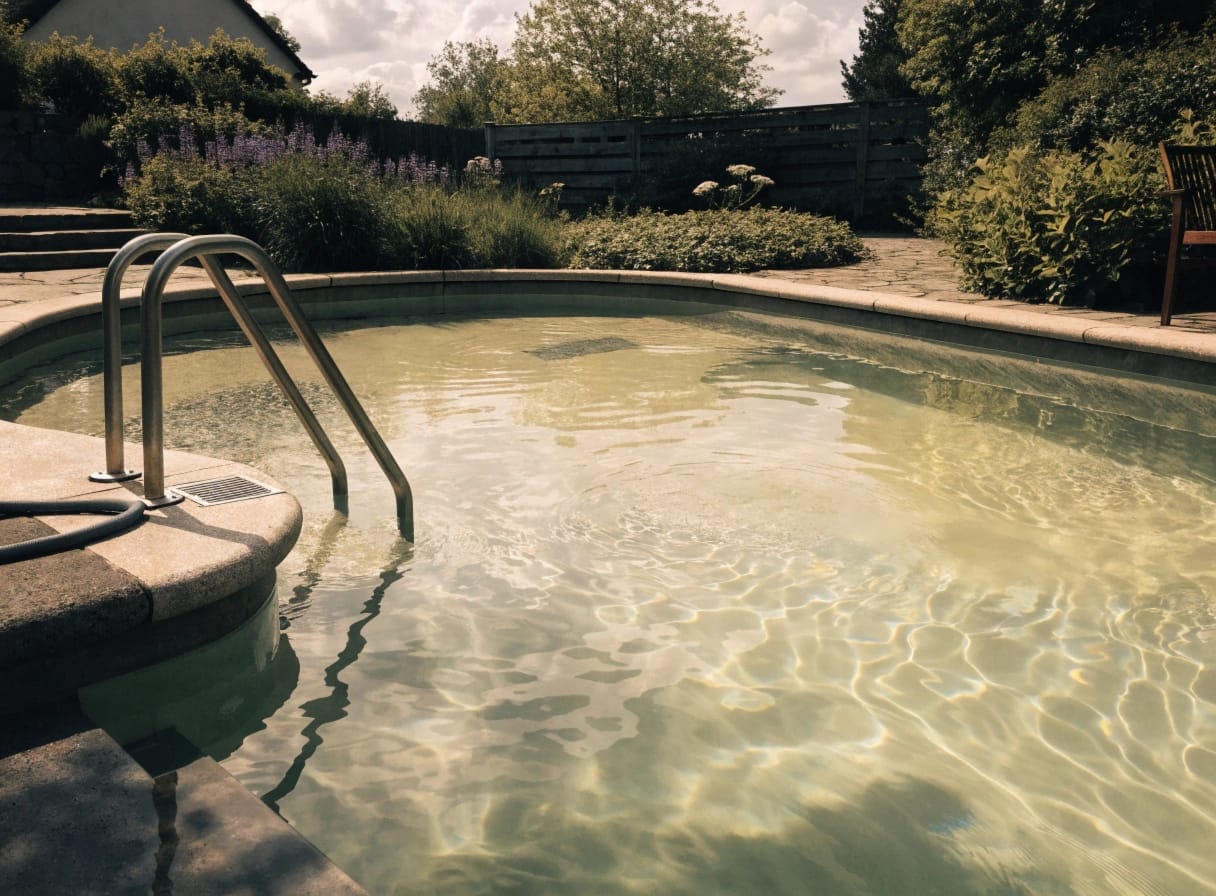
The shade of green tells you how much work is ahead. Light pea-green water with some visibility means algae is in its early stages and one treatment cycle is usually sufficient. Dark, murky green where you cannot see the pool floor means the algae has established properly and you will need a heavier treatment and possibly multiple shock doses. Black-green water with visible algae on the walls indicates a severe, established infestation — at this point, professional treatment is worth considering.
Step 2: Test Your Water
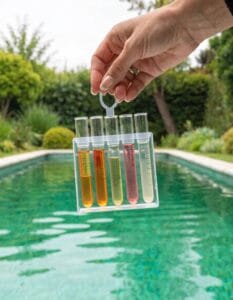
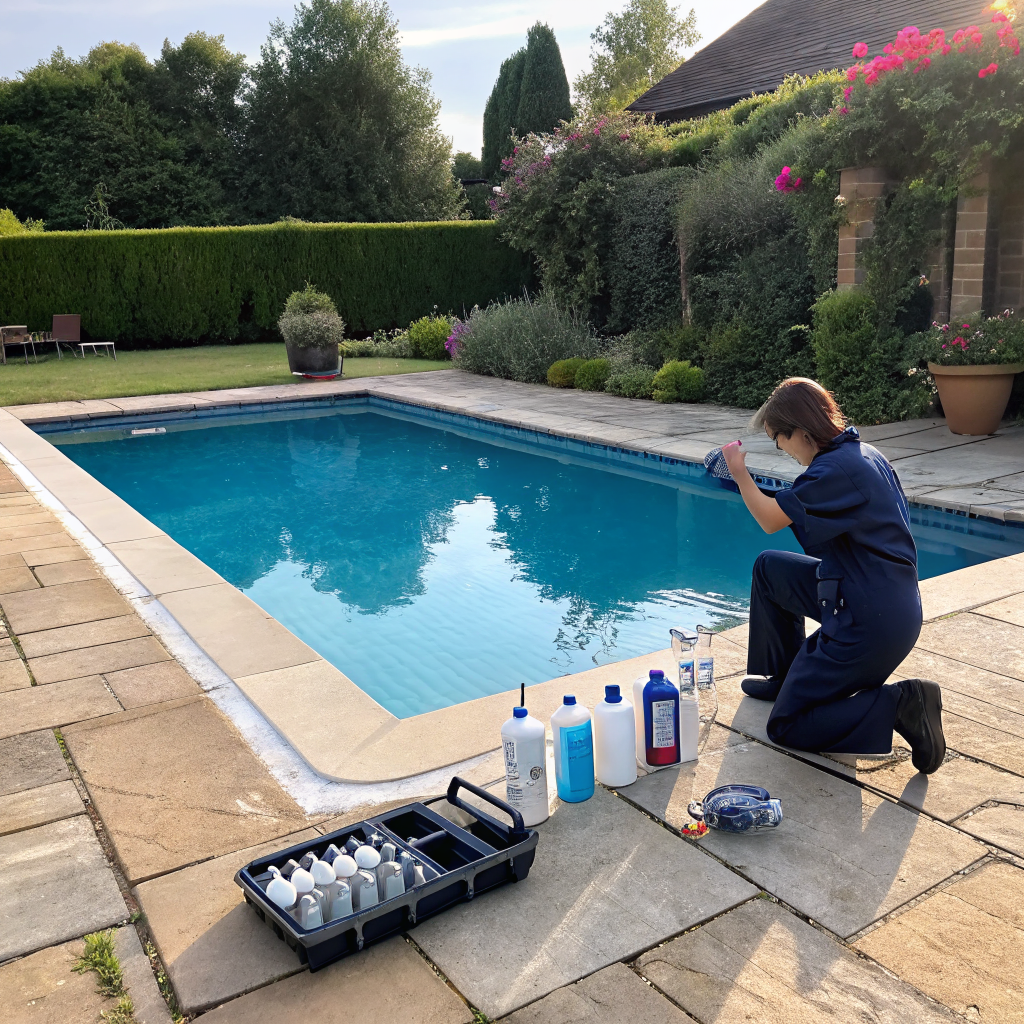
Before adding any chemicals, test pH, total alkalinity, and free chlorine. You need to know where you are starting from. A decent liquid or digital test kit will give you accurate readings. Test strips can work but are less reliable. Record your numbers — you will need them to calculate dosing amounts accurately.
Step 3: Balance pH and Total Alkalinity First
This is the step most people skip, and it is the most common reason a green pool stays green. Adjust TA first, then pH. Your targets are:
| Parameter | Target Range | Why It Matters |
|---|---|---|
| Total Alkalinity | 80–120 ppm | Stabilises pH so it does not drift |
| pH | 7.2–7.6 | Chlorine is most effective in this range |
| Free Chlorine | 1–3 ppm (maintenance) | Primary sanitiser — kills algae and bacteria |
| Cyanuric Acid (Stabiliser) | 30–50 ppm | Protects chlorine from UV degradation |
If pH is high, use pH minus (sodium bisulphate). If TA is low, use an alkalinity increaser (sodium bicarbonate). Allow the pump to circulate the adjustments for at least an hour before retesting and making further corrections.
Step 4: Brush the Pool Thoroughly
Before shocking, brush every surface of the pool — walls, floor, steps, and any features. Algae attach to surfaces with a protective biofilm layer that chlorine struggles to penetrate. Physically breaking that layer up with a stiff pool brush dramatically improves the effectiveness of the shock treatment. Pay particular attention to corners, behind ladders, and any shaded areas.
Step 5: Shock the Pool
Shocking means adding a very high dose of chlorine — typically 5–10 times the normal maintenance dose — to overwhelm and kill the algae. For a green pool, use calcium hypochlorite granules (pool shock), which are available from most pool suppliers. Do not use standard chlorine tablets for this — they dissolve too slowly to achieve the concentrated dose you need.
As a guide for calcium hypochlorite shock with approximately 65–70% available chlorine:
| Algae Severity | Approximate Dose (per 10,000 litres) | Target Free Chlorine |
|---|---|---|
| Light green (early stage) | 150–200 g per 10,000 L | Approx 10 ppm |
| Medium green (established) | 300–400 g per 10,000 L | Approx 20 ppm |
| Dark or black-green (severe) | 500–600 g per 10,000 L | Approx 30 ppm |
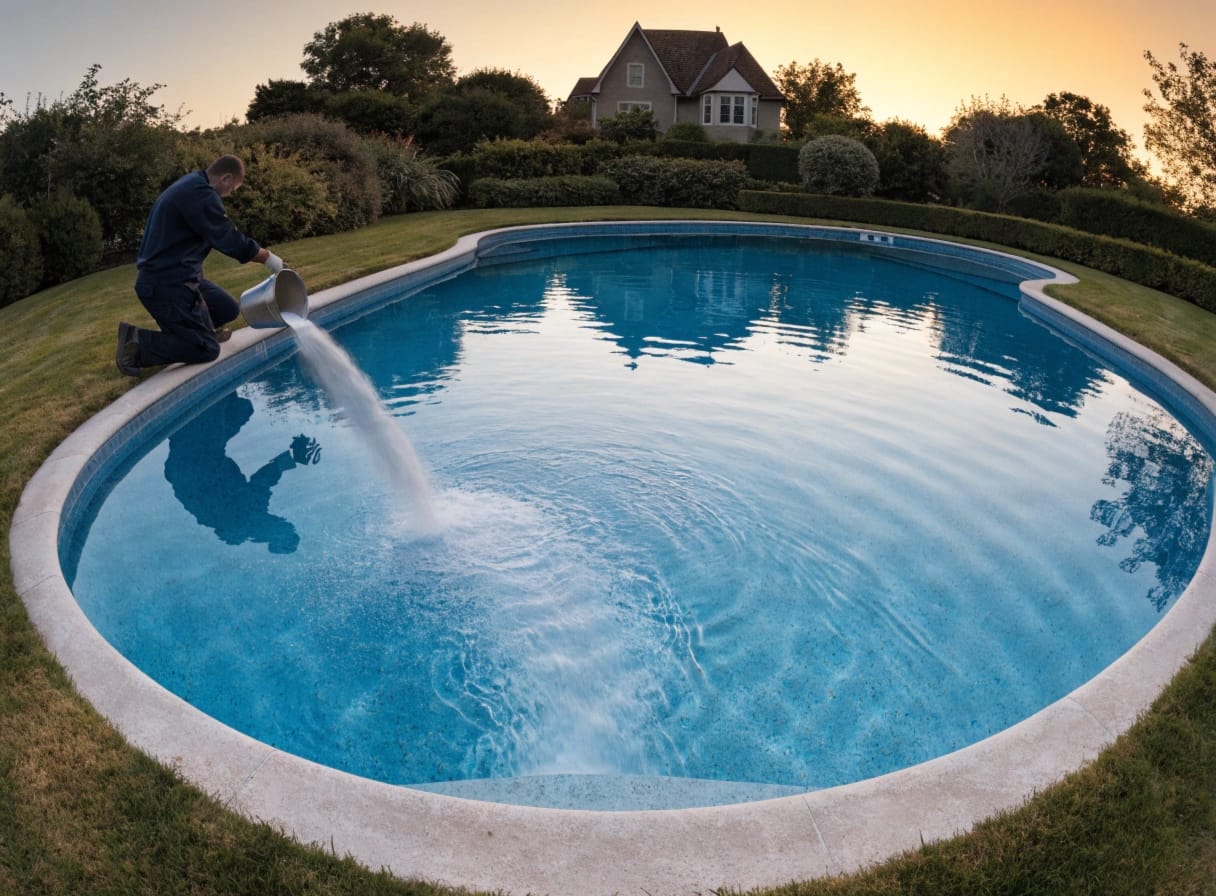
Always pre-dissolve shock granules in a bucket of water before adding to the pool — never pour directly onto the pool surface or into the skimmer. Add the dissolved solution in the evening if possible; sunlight breaks down calcium hypochlorite rapidly, and treating after dark allows the shock to work through the night without UV degradation. With the pump running, distribute evenly around the pool perimeter.
Use the calculator below to get a dosing estimate for your pool before you start.
Pool Shock Dose Calculator
Pool Shock Dose Calculator
Estimates calcium hypochlorite shock dose (65–70% available chlorine) for treating a green pool. Always follow your product's label instructions.
Step 6: Run the Filter Continuously
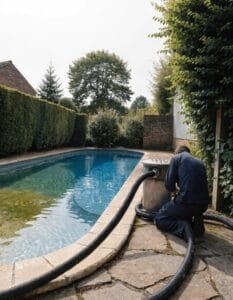
After shocking, run your pool filter continuously for at least 24–48 hours. Do not turn it off. The filter is what removes the dead algae from the water — without it running, the killed algae simply stays in suspension and the water remains cloudy or green. Clean or backwash the filter after 8–12 hours, as it will clog rapidly with dead algae. Then continue running it and backwash again as needed.
Step 7: Add a Flocculant if Needed
If after 24–36 hours the water is no longer green but still hazy or grey, the algae is dead but still suspended in the water in tiny particles too small for the filter to catch efficiently. A pool flocculant (also called a coagulant or clarifier) causes these particles to clump together into larger masses that the filter can remove. Follow the product instructions carefully — flocculants typically require the pump to be off for a period to allow particles to settle, then vacuuming to waste.
Step 8: Retest and Rebalance
Once the water is clear, test all parameters again. The heavy shock dose will have temporarily elevated chlorine well above the safe swimming level — do not re-enter the pool until free chlorine has dropped back to between 1 and 3 ppm and pH is between 7.2 and 7.6. This typically takes 24–48 hours after shocking, depending on the dose, sunlight, and bather load.
How Long Does It Take to Clear a Green Pool?
For a light to medium green pool treated correctly, you should see clear water within 3–5 days. A severe infestation may take 5–7 days, particularly if the filter needs repeated backwashing and the pool requires a second shock dose. The single biggest mistake that extends this timeline is turning the filter off — keep it running continuously until the water is fully clear.
If the pool is still heavily green after 72 hours with the filter running continuously, it typically means either the shock dose was insufficient, the pH is too high for the chlorine to work, or the filter itself is not functioning properly. Test again, rebalance, and apply a second shock dose at the appropriate level.
How to Stop Your Pool Turning Green Again
Treating a green pool is relatively straightforward. Preventing it from happening again requires consistent habits. The good news is that none of them are difficult — they just need to be regular.
Test Your Water at Least Twice a Week in Summer
Water chemistry can shift quickly in warm weather, particularly chlorine levels. Testing twice a week and making small adjustments is far easier than dealing with a full algae bloom. Focus on free chlorine and pH as your primary indicators. If you test and find chlorine below 1 ppm, top up immediately — do not wait until the next scheduled test.
Maintain a Consistent Chlorine Level
The ideal free chlorine range for an outdoor pool is 1–3 ppm. In hot weather or after heavy use, chlorine burns off quickly. Using a combination of slow-release chlorine tablets (which maintain a baseline level in the skimmer or feeder) topped up with granules as needed is the most reliable approach for most domestic pools.
Use a Stabiliser (Cyanuric Acid)
Cyanuric acid, also called pool stabiliser or conditioner, protects chlorine from UV degradation. In direct summer sunlight, unstabilised chlorine can be destroyed within a few hours. A cyanuric acid level of 30–50 ppm means your chlorine lasts significantly longer, reducing both chemical consumption and the risk of levels dropping unexpectedly. Most stabilised chlorine tablets contain cyanuric acid, so levels rise gradually over the season — test CYA periodically and dilute with fresh water if it creeps above 80 ppm.
Run Your Filter for Long Enough
As a rule of thumb, run your pool pump for one hour for every 10°C of water temperature, with a minimum of 8 hours per day during summer. In a heatwave, run it for 12 hours or more. Check that your pump is sized correctly for your pool volume — undersized pumps are a common reason pools struggle to stay clear.
Cover the Pool When Not in Use
A pool cover dramatically reduces the rate at which chlorine degrades, keeps out debris that increases chlorine demand, and reduces water temperature fluctuations. It also stops leaves and organic matter entering the pool — decomposing organic material consumes chlorine and feeds algae. Even a simple solar cover makes a significant difference over the course of a season.
Use an Algaecide as a Preventive Treatment
A weekly dose of a non-staining, polyquat-based algaecide during the swimming season adds an extra layer of protection. Algaecide is not a substitute for chlorine — it works alongside it, breaking down the protective layer on algae cells so chlorine can kill them more effectively. It is far more effective as a preventive measure than a cure. Look for polyquat 60 products, which do not contain copper and therefore will not stain pool surfaces.
When Should You Call a Professional?
Most green pool problems can be resolved with the right chemicals and a methodical approach. But there are situations where professional help is the more sensible route.
If the pool has been green for several weeks, if it has visible black algae growth on the surfaces, or if you have treated it correctly and it keeps going green within days, there is likely an underlying issue — a failing filter, a pump problem, or a more persistent chemical imbalance — that needs a professional diagnosis. Similarly, if the green is accompanied by unusual staining or a metallic sheen on the water, you may have a metals issue (iron or copper) rather than pure algae, which requires a different treatment approach.
At DP Pool Services, we regularly treat pools that have turned green and help owners get to the root cause so it does not keep recurring. Our pool maintenance service covers chemical balancing, water testing, filter servicing, and seasonal treatments across Bedfordshire, Hertfordshire, Buckinghamshire, Essex, Cambridgeshire, Northamptonshire and Greater London.
Got a Green Pool? We Can Help
If your pool has turned green and you would like a professional to treat it — or you want regular maintenance to prevent it happening — get in touch with DP Pool Services. We are a family-run business with over 30 years of experience caring for pools across the South of England.
Call us on 07748 142023 or get in touch online for a free, no-obligation quote.
Green Swimming Pool: Frequently Asked Questions
Why did my pool turn green overnight?
A pool that turns green very quickly — overnight or within 24 hours — indicates that chlorine levels dropped to near zero, usually due to heavy sunlight, hot weather, or heavy bather load consuming it faster than usual. Once free chlorine falls below 1 ppm, algae can establish and spread within hours. Test your water first, then follow the shock treatment process above.
Can I just add lots of chlorine to fix a green pool?
Chlorine alone may not be enough if the pH is wrong. High pH (above 7.8) makes chlorine almost inactive. You need to balance pH to between 7.2 and 7.6 first, then shock with an appropriately large dose of chlorine. Skipping the pH step is the most common reason shock treatments do not work.
How much shock do I need to clear a green pool?
It depends on your pool volume and the severity of the algae. As a general guide using calcium hypochlorite shock (65–70% available chlorine): light green needs around 150–200 g per 10,000 litres; medium green around 300–400 g per 10,000 litres; dark or black-green up to 500–600 g per 10,000 litres. Use the calculator above to estimate the dose for your pool. Always check your product's specific instructions — formulations vary.
My pool is green but my chlorine reading is high — why?
This is usually a pH problem. If pH is above 7.8, chlorine becomes chemically inactive even though your test kit shows a reading — it is measuring total chlorine, not the active form. Drop the pH to between 7.2 and 7.6 first and the chlorine you already have should start working. Alternatively, very high cyanuric acid levels (above 80 ppm) can over-stabilise the chlorine, a condition sometimes called "chlorine lock".
How long after shocking can I swim?
Do not swim until free chlorine has returned to between 1 and 3 ppm and pH is between 7.2 and 7.6. After a heavy shock dose, this typically takes 24–48 hours. Always retest before allowing anyone in the water — do not estimate based on time alone.
Why does my pool keep turning green even when I treat it?
If your pool repeatedly turns green despite regular treatment, there is usually an underlying issue: the filter may not be running long enough or may need servicing; the pump may be undersized; cyanuric acid levels may have built up too high; or there may be a persistent low-pH problem driving chlorine levels down. A professional water test and filter inspection will usually identify the root cause.
Can algaecide replace chlorine?
No. Algaecide works alongside chlorine but cannot replace it. Algaecides are most effective as a preventive measure — they disrupt algae's protective layer and make it more susceptible to chlorine. They do not contain enough active ingredient to sanitise the water on their own. Maintain your chlorine levels and use algaecide as a weekly supplement, not a primary sanitiser.
Key Takeaways
- A green pool almost always means algae, caused by a failure of chlorine — usually due to low chlorine levels, high pH, poor filtration, or a combination of all three.
- Do not swim in a green pool — algae growth signals sanitiser failure, which means bacteria may be present.
- Balance pH to 7.2–7.6 before shocking — chlorine is largely ineffective above pH 7.8, which is why many shock treatments fail.
- Shock dose depends on severity: use roughly 150–200 g of calcium hypochlorite shock per 10,000 litres for a light green pool, up to 500–600 g for a severe infestation.
- Run the filter continuously for 24–48 hours after shocking — this is what actually clears the dead algae from the water.
- Prevention is far easier than cure: test water twice a week, maintain 1–3 ppm free chlorine, keep pH between 7.2 and 7.6, and use a weekly algaecide during the swimming season.
Related Articles
- Swimming Pool Maintenance Services from DP Pool Services — find out how our team keeps pools across the South of England clean and balanced all year round.
- DP Pool Services — Pool Building, Renovation and Servicing — everything we do, from new builds to regular servicing contracts.
0 Comments